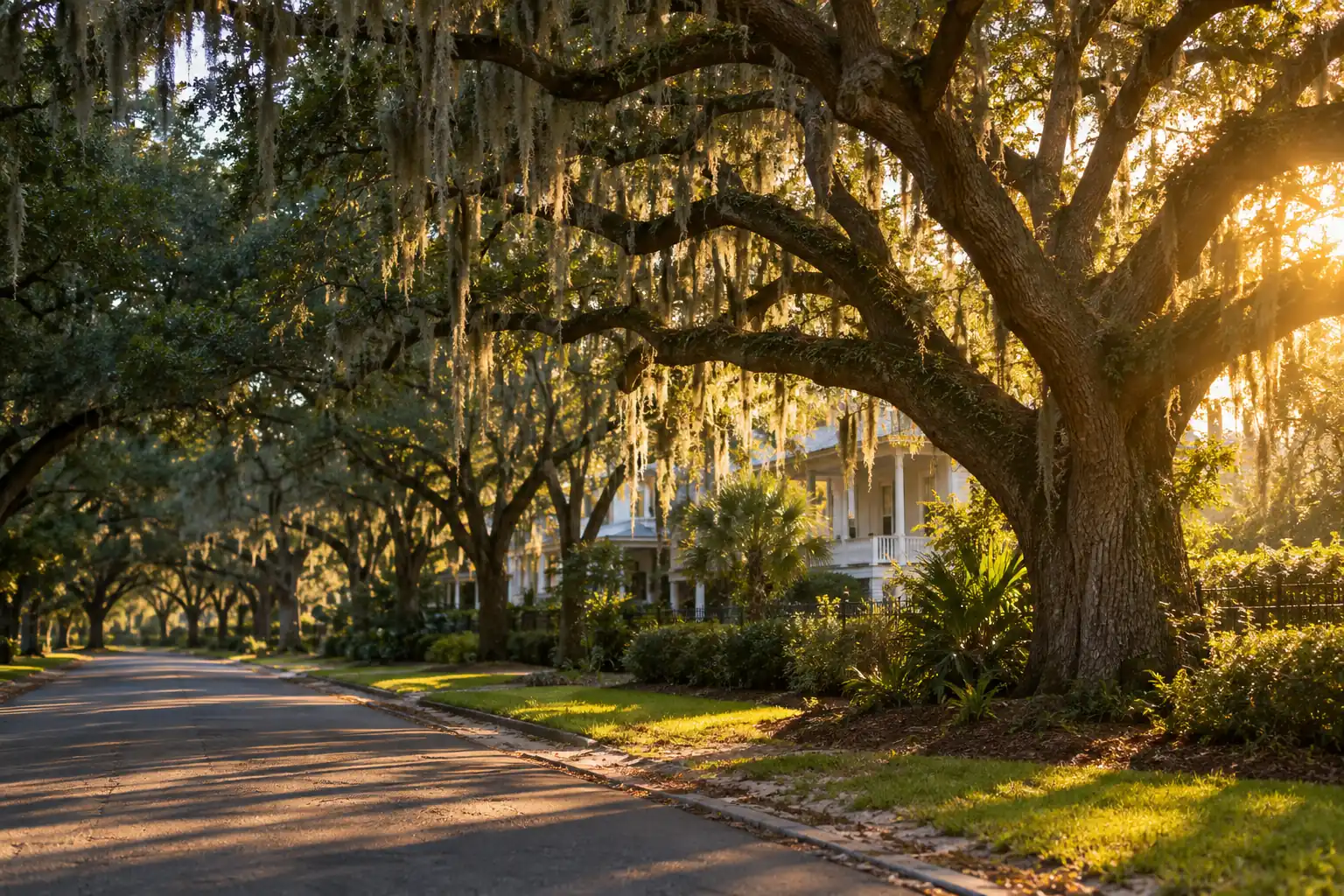
What does a tree removal service include?
A tree removal service takes the tree down, usually in sections, and cuts it up. Cleanup, haul-away and stump grinding are often quoted separately, so ask the crew to list each part in writing.
- The removal itself: climbing or a bucket truck, and rigging pieces down on ropes.
- Cleanup and haul-away: what happens to the wood and brush.
- The stump: left, or ground below grade. Need tree and stump removal together? Ask for both in one quote and see the stump grinding cost guide.
- The permit: who applies, if your town requires one. See the permit guide.
If the tree has already fallen on the house or is blocking the driveway, that is an emergency tree removal job.
Do I need a permit to remove a tree in Charleston?
It depends on where the property is. The Charleston area is split among several cities, towns and the county, and each one has its own tree rules. Four questions settle most cases before any tree is cut:
- Which town is the property in? City limits and unincorporated Charleston County follow different rules, so start with the office that covers your address.
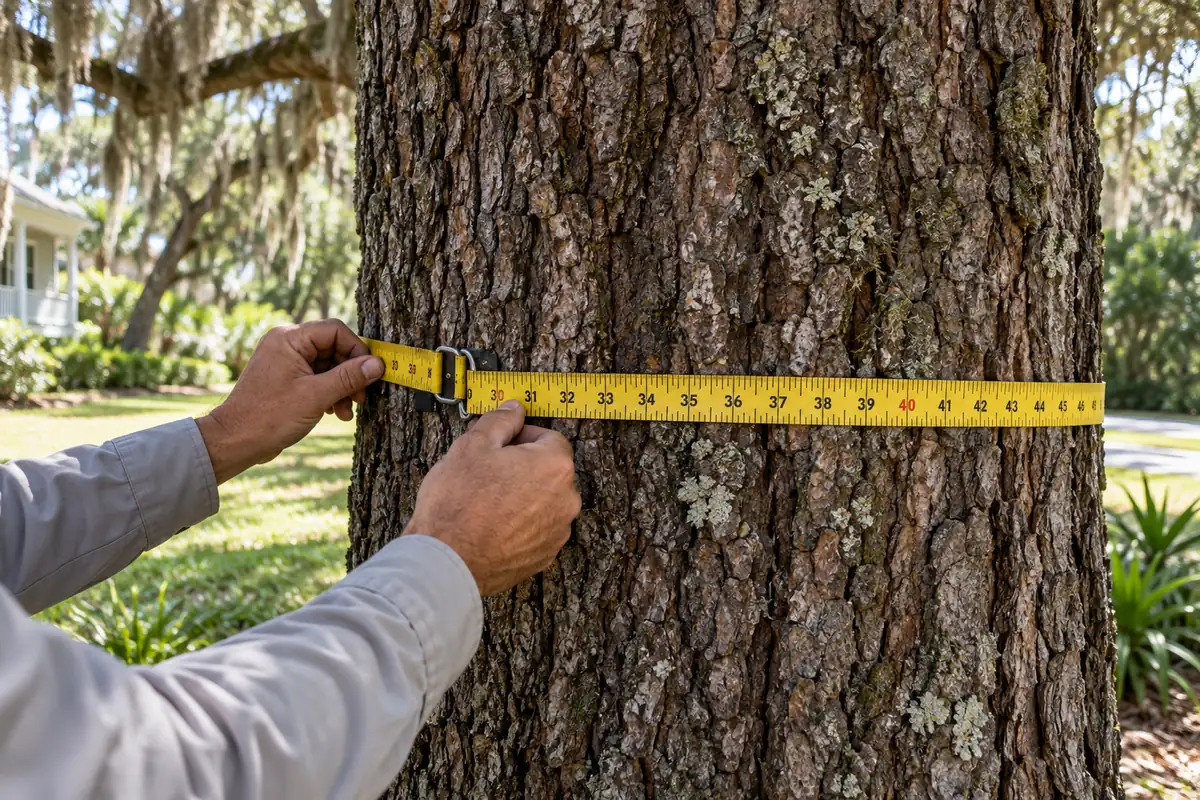
- How wide is the trunk? Measure DBH, the trunk diameter 4.5 feet above the ground. In the City of Charleston and unincorporated Charleston County the line is 24 inches (a grand tree). In Mount Pleasant it is 16 inches, or 24 for pines.
- What species is it? Pines and sweetgums are left out of the grand tree rule in the City and the county, and Mount Pleasant exempts species such as sweetgum and Bradford pear.
- Who applies? In North Charleston the contractor applies for the permit. Elsewhere, ask the crew in writing.
The rules for each town, with phone numbers and the official page, are below.
City of Charleston
Trees under 24 inches DBH on single-family or duplex lots do not need a removal permit. Grand trees, 24 inches DBH or larger (pines and sweetgums excluded), have separate rules, so call Citizen Services at 843-724-7311 before removing one. Official page: City of Charleston tree removal information.
Mount Pleasant
Trees on residential lots that are 16 inches DBH or larger are protected and need approval before removal, with exceptions for species such as sweetgum, Callery (Bradford) pear, river birch and Leyland cypress. Pines are protected at 24 inches or more. The application fee is $50. Contact trees@tompsc.com or 843-884-1229. Official page: Town of Mount Pleasant trees.
North Charleston
The contractor you hire applies for the tree removal permit (owners apply only when they remove the tree themselves). The application needs the contract with the scope of work and, where there is one, approval from your HOA. Fees start at $30; see tree service in North Charleston. Zoning: 843-740-2581. Official page: North Charleston tree removal permit.
Unincorporated Charleston County
Grand trees, 24 inches DBH or larger (pines and sweetgums excluded), cannot be removed without a Grand Tree Removal Permit. It is generally granted when the tree is dead, diseased, dying or a hazard; otherwise the Board of Zoning Appeals decides. Heavy pruning of a grand tree can also require a zoning permit. Official guide: Charleston County tree ordinance (PDF).
Summerville, Goose Creek and other towns set their own rules, so check with the local planning office. Rules were checked against the official pages above in October 2026.
Side-by-side rules for 14 cities, towns and counties, with fees, penalties and official links, are in our tree removal permit guide for Charleston, SC.
How do you get a tree removal quote?
Tell us your address and which tree needs to come out, and we match you with an insured, locally owned tree removal company that works in your area. The crew looks at the tree and gives you a written quote that is free, with no obligation to book.
- Ask for a quote on the quote form or by phone.
- We match you with a local crew (how it works).
- Compare the written quote: the tree, cleanup, the stump and the permit. Prices by town are in our tree removal cost guide.
What should a written tree removal quote list?
- The tree: which one, where it stands and roughly how tall it is.
- The method: climbing, bucket truck or crane, and how the roof, fence and lawn are protected.
- Cleanup: chipping, haul-away, and whether the wood stays or goes.
- The stump: left, cut flush or ground, and how deep.
- The permit: who applies and who pays the fee.
- Insurance: proof of liability and workers’ compensation coverage.
When should a tree be removed?
Most tree removals in the Lowcountry fall into a few groups. The tree is dead or dying, with bare limbs in summer, loose bark or mushrooms at the base. It shows decay: a hollow or split trunk, deep cracks where big limbs join, or rot in the roots. It is leaning toward the house and the lean is new or getting worse, often after storm damage. Or its roots are lifting a driveway, sidewalk or foundation.
The International Society of Arboriculture (ISA) lists the same kind of warning signs in its homeowner guide, including dead branches, cracks, decay and a tree that has started to lean (ISA, recognizing tree risk (PDF)). A crew or an ISA Certified Arborist can tell you which ones are serious on your tree.
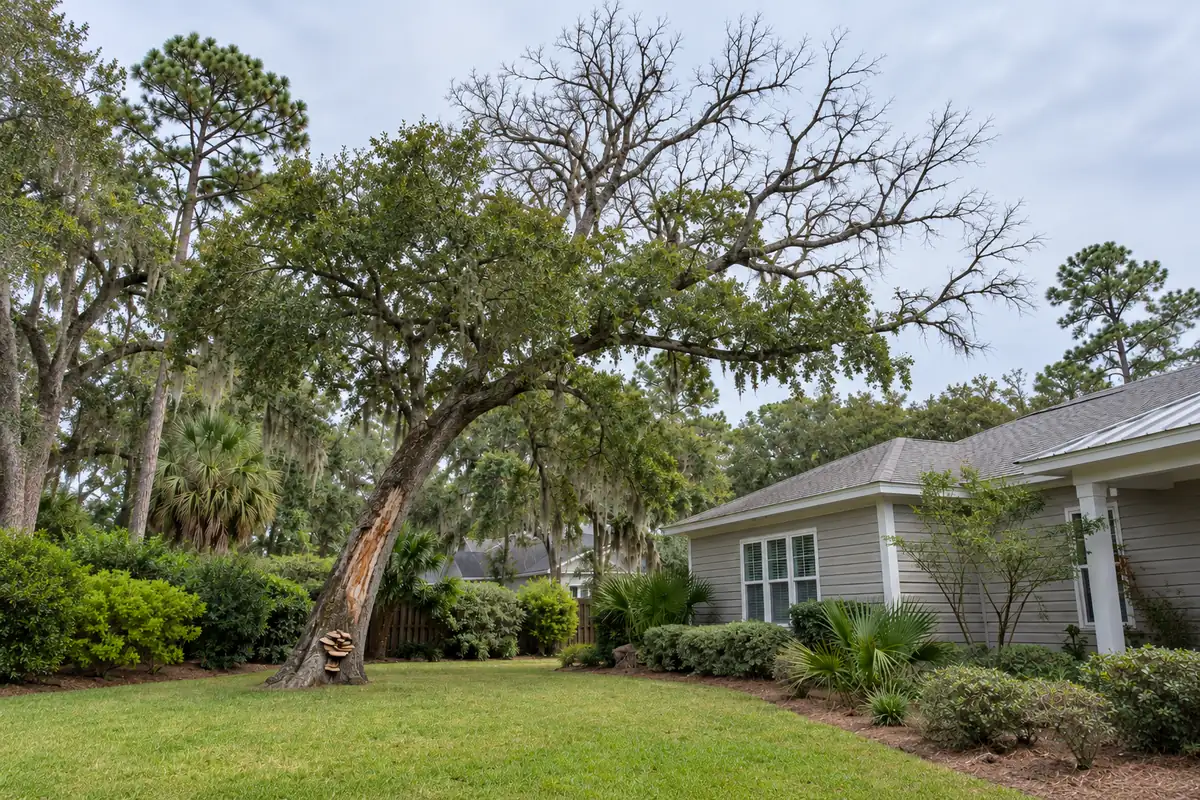
A hazardous tree close to the house, power lines or a neighbor’s property is worth dealing with before hurricane season, which runs from June 1 to November 30. A crew can tell you on site whether the tree has to come down or whether trimming the tree instead is enough. If a tree has already fallen on the house or is blocking the driveway, go straight to emergency tree removal. Our hurricane tree preparation checklist lists the warning signs to look for. Not sure whether the tree needs to come out? Our trimming vs. removal guide has a decision table.
Planned removal or storm-damaged tree: which one is it?
A planned removal is a standing tree you want gone: dead, leaning, too close to the house or in the way. You have time to compare a written quote and check the permit rules first. A storm-damaged tree is one that has already failed or split and is on the house, a car or the driveway; that is an emergency job.
| Planned removal | Storm-damaged tree | |
|---|---|---|
| Timing | Usually scheduled within days | As soon as a crew can safely reach it |
| First step | Written quote and permit check | Get people clear; call the utility if lines are down |
| Where to start | Request a quote | Emergency tree removal |
Hazardous trees are easier to deal with before the Atlantic hurricane season than during it. NOAA’s National Hurricane Center puts the peak of the season on September 10, with most activity between mid-August and mid-October, so spring and early summer are the calmer months to book a planned removal.
How is a tree removed safely?
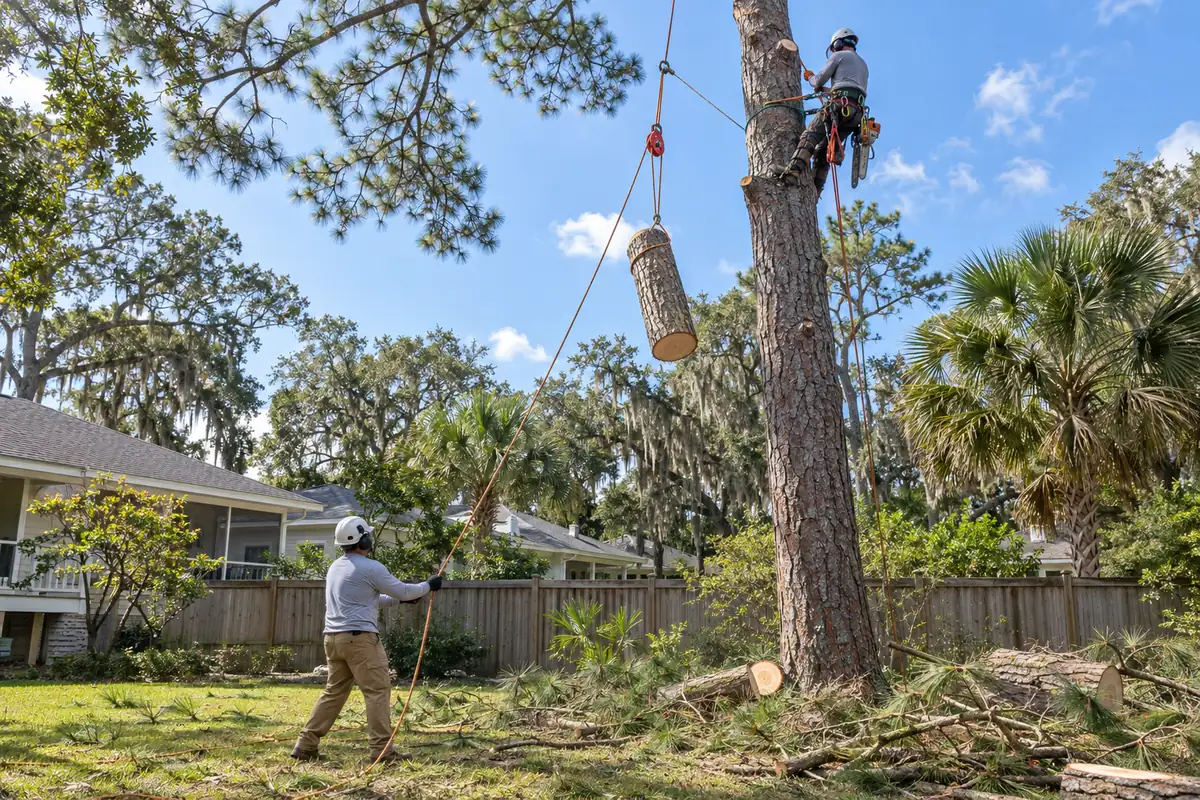
Few trees near Charleston homes can be dropped in one piece. On a typical lot a professional crew climbs the tree or works from a bucket truck and takes it down in sections, lowering each piece on ropes (called rigging) so it does not hit the roof, fence or lawn.
The safety standard for this work in the United States is ANSI Z133, published by ISA. Its newest edition, Z133-2026, came out on May 27, 2026 (ISA, Z133-2026 announcement). It is fair to ask a crew whether they follow it.
Large live oaks and trees leaning over a house often need a crane. It adds to the price, but it is the safest way to lift heavy wood over a structure. Trees touching or near power lines are a separate job: the utility usually has to be involved, and only crews trained for line clearance should work near energized lines. Under federal OSHA rules, workers who are not qualified for electrical work must stay at least 10 feet from energized lines up to 50 kV (OSHA 1910.333).
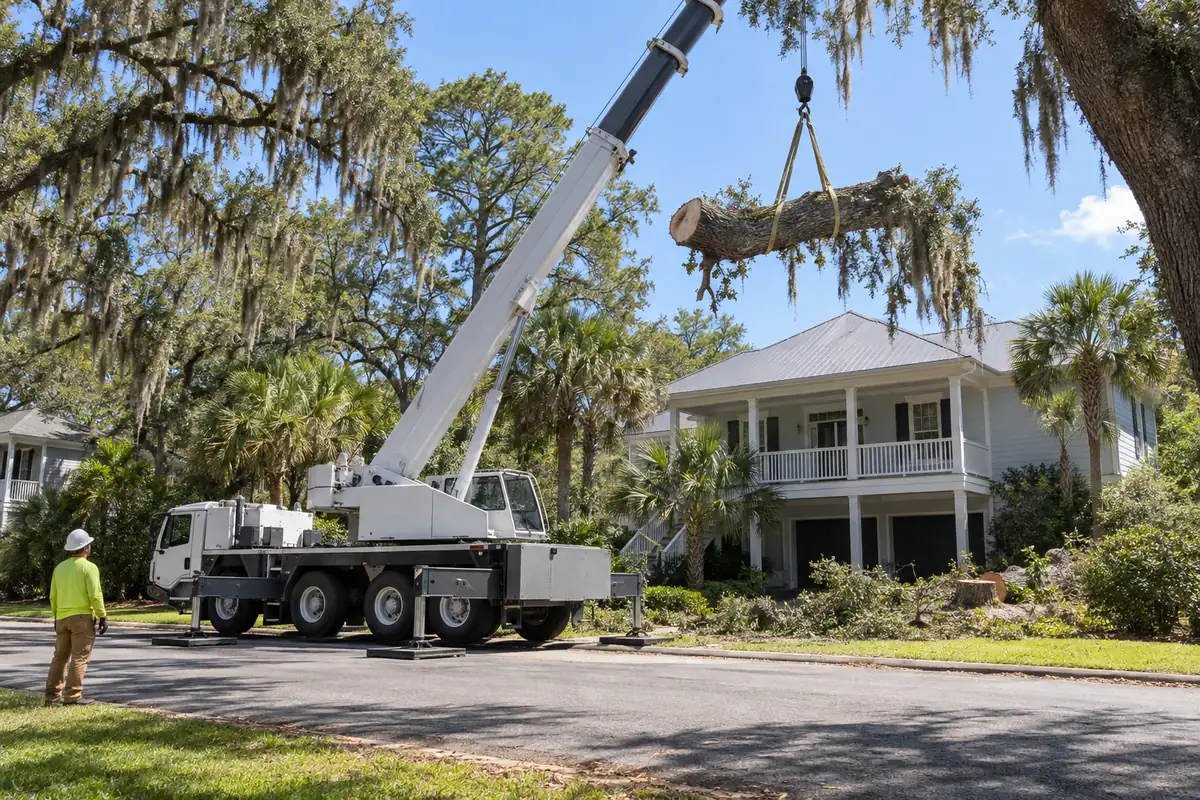
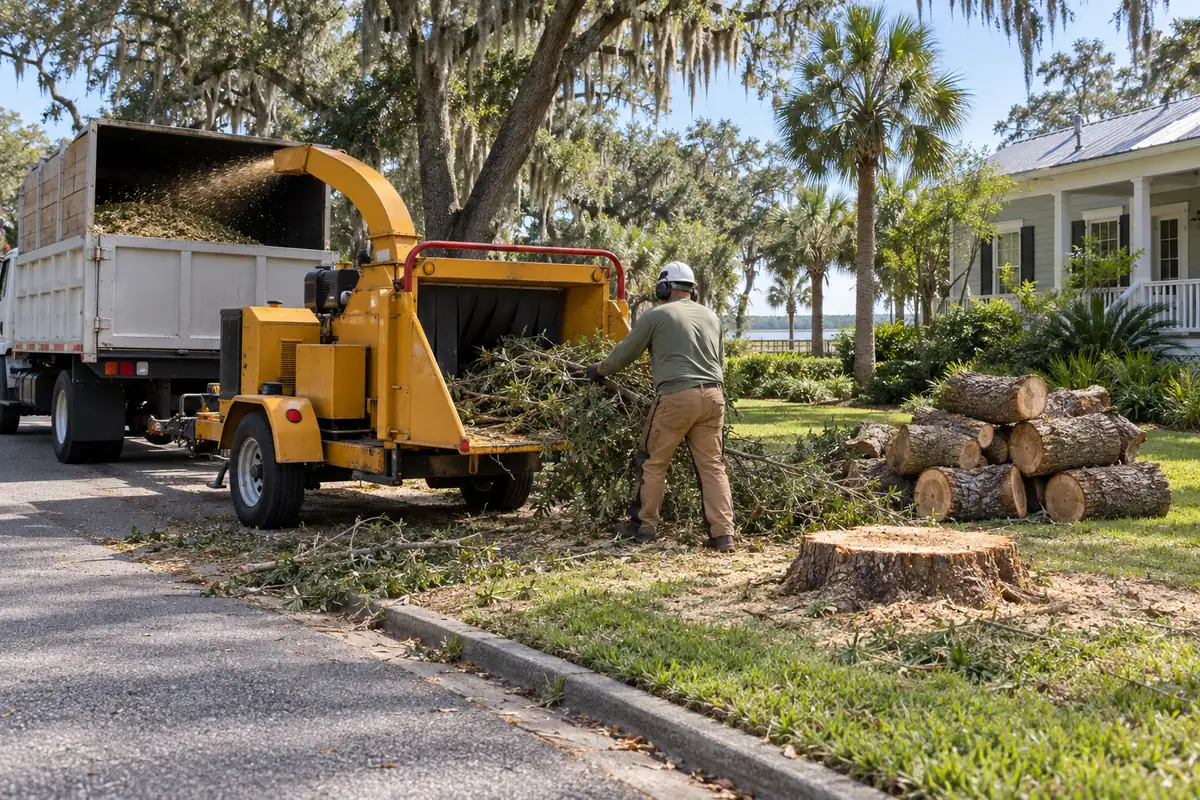
Most tree removal services include cleanup: once the tree is down, the crew chips the branches, cuts the trunk into rounds and hauls the debris away, unless you agree to keep the wood for firewood.
Live oaks, pines and palmettos: how the species changes the job
Some Lowcountry trees hold up to hurricanes far better than others. A UF/IFAS study of 10 hurricanes and about 18,200 trees rates live oak and sabal palm among the most wind-resistant species, loblolly pine as medium-low, and laurel oak and water oak as low (UF/IFAS, selecting coastal plain species for wind resistance). The same fact sheet cites a study after Hurricane Hugo in the South Carolina coastal plain, where live oaks were less damaged than laurel and water oaks.
- Live oak: wind-firm and often worth saving. At 24 inches DBH or more it is a grand tree in the City of Charleston and the county, so check the permit rules above before it comes down.
- Laurel oak and water oak: rated low for wind resistance, so a declining one near the house is worth an inspection.
- Loblolly pine: rated medium-low. Pines are left out of the grand tree rule in the City and the county, but Mount Pleasant protects pines at 24 inches or more.
- Sabal palmetto: among the most wind-resistant trees in the study. Removing dead fronds is often enough.
The authors are clear that no species is windproof: soil, age, health and the storm itself all matter. A crew that sees the tree gives the real answer.
How much does tree removal cost in Charleston?
LawnStarter lists Charleston averages of about $375 for a small tree, $808 for a medium tree and $1,862 for a large tree (source: LawnStarter, Charleston tree care). For comparison, Homeyou puts a medium tree at $487 to $664, so prices vary by crew and site.
What moves the price: height and trunk diameter, how close the tree is to the house or power lines, whether a crane is needed, access for equipment (a backyard behind a narrow gate takes longer than an open front yard) and how much cleanup you want.
Stump grinding and haul-away are often quoted separately. Ask for a written quote that lists what is included, and see stump grinding for that part of the job.
The same sourced numbers are compared across towns. Prices by town, with each town’s permit fee, are in our tree removal cost guide.
What should I ask before hiring a tree removal company?
Ask for the company’s business license and proof of liability and workers’ compensation insurance, a written quote that lists cleanup, stump grinding and haul-away, and how the crew will protect your roof, fence and lawn. Ask who pulls the permit when one is needed. Our checklist for hiring a tree service has the full list, with sources.
For a large live oak or a tree you might want to save, ask whether an ISA Certified Arborist will look at it first; you can check a credential in the ISA arborist directory. Avoid anyone who asks for full payment before the work starts. To keep a live oak or palmetto healthy instead, see our tree care guide.
Tree removal across the Charleston area
We connect homeowners with tree removal companies in Mount Pleasant, West Ashley, James Island, Johns Island, Daniel Island, North Charleston, Summerville, Goose Creek and the rest of the Tri-County area. See the full list of service areas, every tree service in Charleston we refer, or request a free quote. Not sure how a referral works? Read how our referral service works.
Searching for tree removal near me? Requests come in from Mount Pleasant, North Charleston and Summerville, and we match each one with a crew that works in that area.
Sources we checked for this page
Every rule and number on this page links to its source. The main ones, checked in November 2026:
- Permit rules: the official pages of the City of Charleston, Town of Mount Pleasant, City of North Charleston and Charleston County (PDF).
- Wind resistance by species: UF/IFAS Extension, FR174.
- Warning signs: ISA, recognizing tree risk.
- Safety: ANSI Z133-2026 (ISA) and OSHA 1910.333.
- Hurricane season dates: NOAA National Hurricane Center.
- Prices: LawnStarter and Homeyou.
This site is a referral service, not a tree company. Found something out of date? Tell us on the contact page.
Frequently asked questions
How fast can a tree be removed?
Routine removals are usually scheduled within days. A tree that fell on a house or blocks a driveway is handled as an emergency (see the emergency tree removal page).
How much does it cost to remove a tree in South Carolina?
In the Charleston area, LawnStarter averages run from about $375 for a small tree to $1,862 for a large one. A tree over the house that needs a crane can cost more. The reliable number is a written quote after someone sees the tree.
When is the best time of year to remove a tree, and is it cheaper in winter?
If the tree is dead, cracked or leaning, do not wait for a better season. For a planned removal, LawnStarter says late winter or early spring is the most convenient time, and its Charleston demand chart is lowest in December and January, so crews are likeliest to have open dates then. Spring and early summer are also calmer than the hurricane peak on September 10. LawnStarter publishes no price by month, so ask each crew whether the date changes the quote.
Which trees hold up best in a hurricane in Charleston?
A UF/IFAS study of 10 hurricanes rates live oak and sabal palm among the most wind-resistant species, loblolly pine as medium-low, and laurel oak and water oak as low. No tree is windproof, so have a crew look at any tree that leans toward the house.
Is the quote free?
Yes. You describe the job, a local crew gives you a quote, and you decide whether to hire them.
Who does the work?
An independent, locally owned tree service company that carries its own insurance. This site is a referral service and does not perform tree work.
How do I find tree removal near me?
Enter your address on the quote form and we match you with an insured, locally owned crew that works in your area, from downtown Charleston to Summerville. The quote is free and there is no obligation.
What does a tree removal service include?
The crew takes the tree down, usually in sections, and cuts it up. Cleanup, haul-away and stump grinding are often quoted separately, so ask for each in writing.
Can I get tree and stump removal in one quote?
Yes, ask for both. LawnStarter lists stump grinding at an average of $223 in Charleston; see our stump grinding cost guide for prices by town.