Trimming vs. pruning: what is the difference?
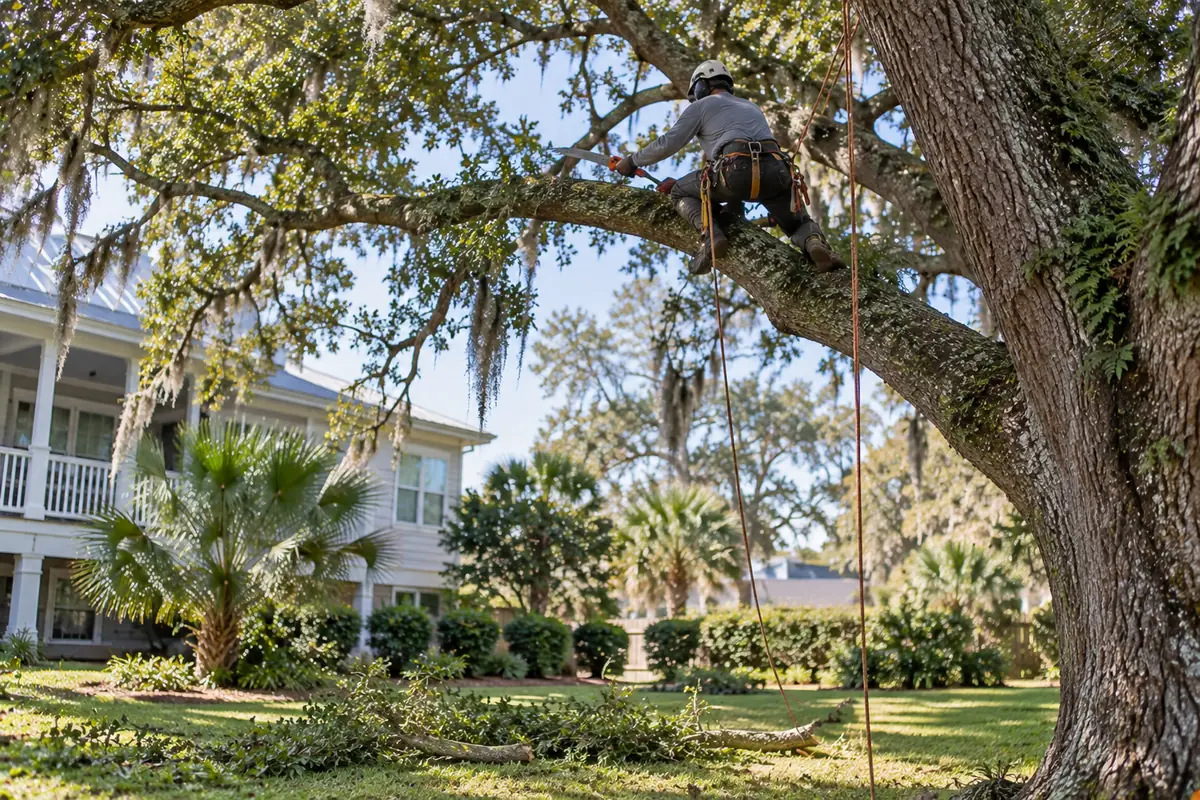
In practice, homeowners and tree companies use both words for the same job: cutting branches selectively, without taking the tree down. What matters is the type of pruning. The International Society of Arboriculture (ISA) describes four:
Cleaning (deadwooding) removes dead, dying, diseased and weakly attached branches. Thinning reduces the density of the outer crown so more wind and light pass through. Raising removes lower branches to clear the house, driveway, sidewalk or street. Reduction shortens the tree back to smaller branches that can take over, often to clear utility lines (source: ISA, pruning mature trees).
What you should not get is topping: cutting branches back to stubs. ISA calls it perhaps the most harmful pruning practice, and Clemson Extension is direct: never top trees (Clemson HGIC, tree maintenance).
Why trim before storm season?
Storm season in the Lowcountry is the Atlantic hurricane season, June 1 through November 30. Dead limbs, cracked branches and heavy limbs hanging over the roof are usually what breaks first in a Lowcountry storm, and they are what a cleaning and roof-clearance job removes.
Trimming lowers the risk; it does not storm-proof a tree. A tree with a hollow trunk, root rot or a worsening lean may need to come down instead (see tree removal). If a storm has already brought a tree or limb down on the house, that is an emergency tree removal job.
Live oaks, pines and palms
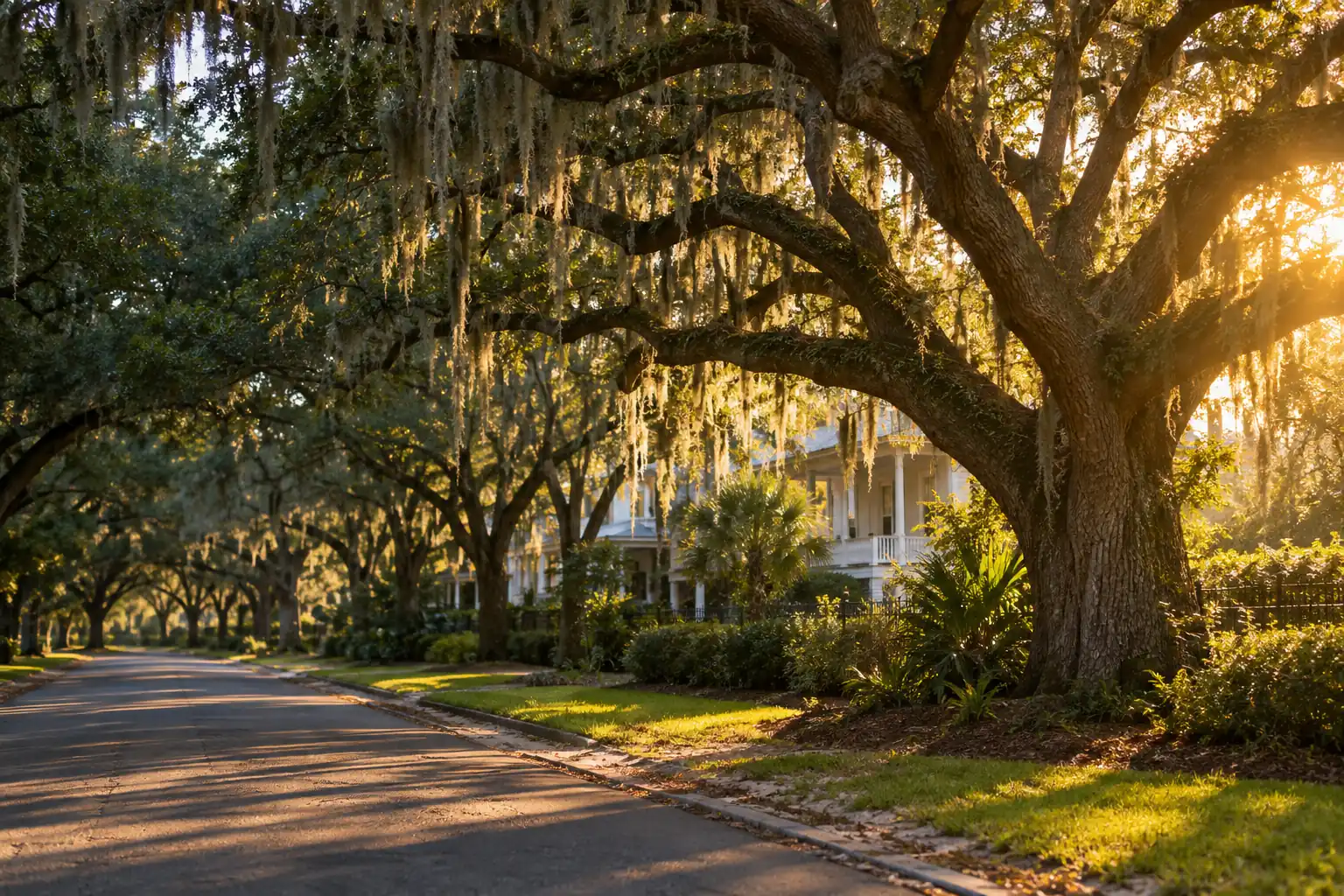
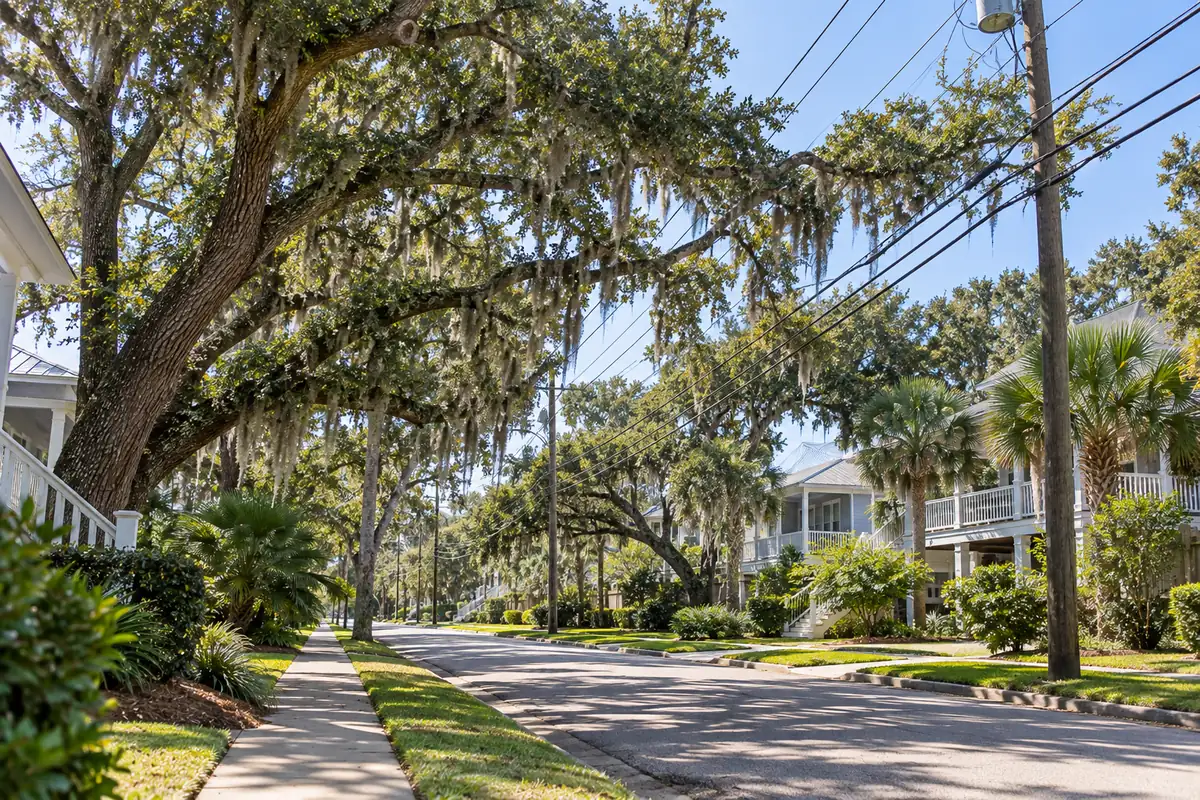
Live oaks are part of what makes Charleston look like Charleston, and the best pruning is usually light. Clemson Extension says live oak pruning is mainly needed early in the tree’s life, to build a strong branch structure, and advises pruning in mid-to-late summer to avoid oak wilt disease (Clemson HGIC, live oak).
Spanish moss does not need to be stripped out. Clemson explains that it takes no water or nutrients from the tree; it shows up most on trees that are already declining for another reason (Clemson HGIC, Spanish moss).
For palms and sabal palmettos, less is more. UF/IFAS Extension’s first rule is to never remove live, green, healthy fronds, and it found that “hurricane-cut” palms, stripped down to a few fronds at the top, were more likely to have their crowns snapped off by wind (UF/IFAS, pruning palms). Removing dead fronds is fine.
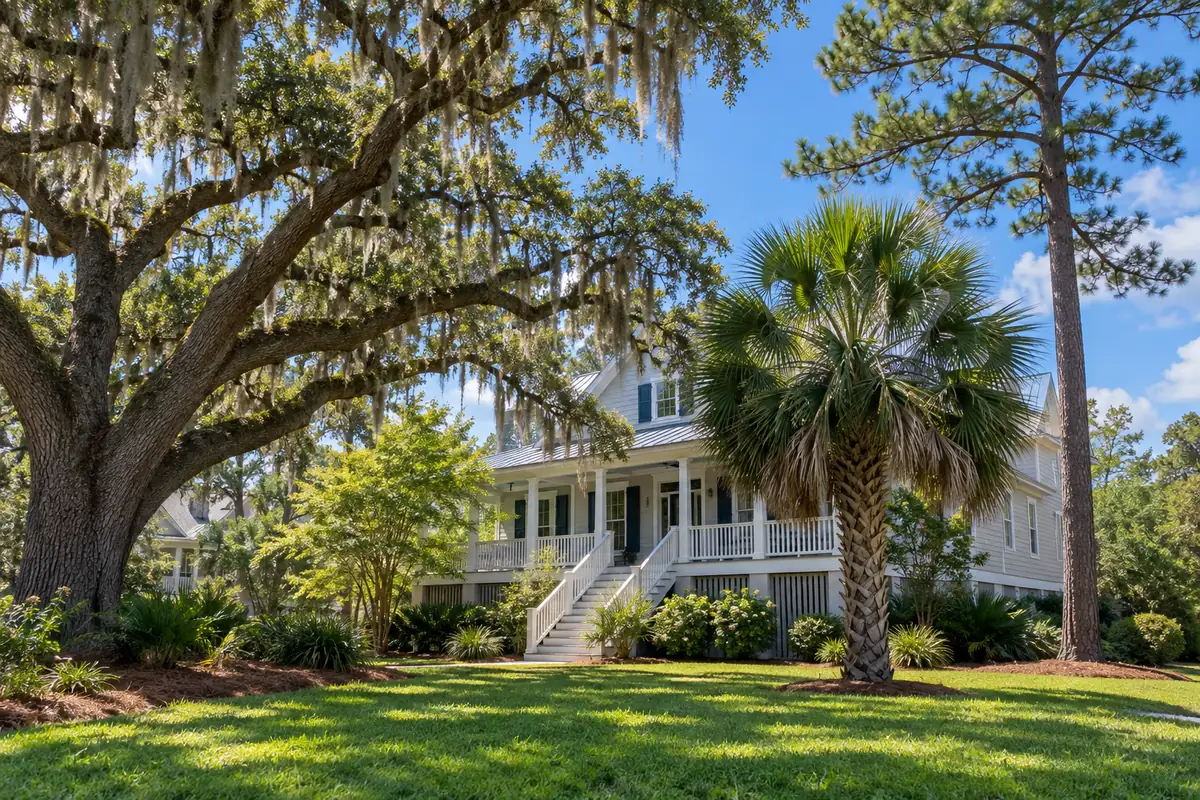
For pines, the usual work is removing dead limbs and raising branches over the roof. On a large live oak, it is fair to ask two things: does the crew prune to the ANSI A300 pruning standard, the industry standard for tree care in the United States, and is there an ISA Certified Arborist on the job?
When is the best time to trim trees?
Light pruning to remove dead, weak or diseased limbs can be done at any time of year, according to ISA. Heavier pruning is best done before the spring growth flush and avoided right after it, when the new leaves have just come out (ISA). Clemson Extension points to late February for shade trees in South Carolina, and to waiting until after the flowers fade for spring-flowering trees (Clemson HGIC, when to prune).
Live oaks are the exception noted above: Clemson advises mid-to-late summer. Either way, getting hazardous limbs off the roof before hurricane season is better than waiting for the perfect month.
Who trims branches over a property line in South Carolina?
South Carolina has no statute that expressly gives you the right to cut a neighbor’s branches that hang over your yard. What the law does say is that it is a crime to willfully and maliciously cut, mutilate or injure another person’s tree (S.C. Code § 16-11-520). Bills filed in 2025 to add an exception for trimming limbs that cross your property line (H.3624 and S.39) were still sitting in committee, not law, as of October 2026.
A Charleston law firm describes the generally accepted approach as trimming only up to the property line, at your own expense, from your side, without seriously damaging the tree (Charleston law firm guide to overhanging limbs). Talk to your neighbor first, get any agreement in writing, and for a real dispute speak with a lawyer. This is general information, not legal advice.
Branches near power lines
Do not trim, and do not let a regular tree crew trim, branches near overhead power lines. Under federal OSHA rules, workers who are not qualified for electrical work must stay at least 10 feet from energized lines up to 50 kV (OSHA 1910.333). Only line-clearance crews can work closer.
Call your utility first: Dominion Energy South Carolina or Berkeley Electric Cooperative, depending on your address. Berkeley Electric trims trees in its rights-of-way and asks members to report a tree creating an electrical hazard to its district office at 1-800-327-9615 (Berkeley Electric safety).
How much does tree trimming cost in Charleston?
In Charleston, trimming averages about $113 for a small tree, $396 for a medium one and $760 for a large one, according to LawnStarter (source: LawnStarter, Charleston tree care).
What moves the price: tree height and spread, how many trees are trimmed in one visit, whether limbs are over the roof or near lines, access for a bucket truck and whether cleanup and hauling away the branches are included. Ask for a written quote that says which limbs come off and what type of pruning will be done.
Trimming requests come in from downtown, Mount Pleasant, West Ashley, James Island and Daniel Island out to North Charleston, Summerville and Goose Creek, and we match each one with a crew that works in that area. Check the areas we cover or ask for a trimming quote.
Frequently asked questions
How often should trees be trimmed?
It depends on the tree. Clemson Extension recommends structural pruning every 2 to 3 years for young trees, through about the tenth year after planting. Mature trees near the house are worth having checked by a certified arborist, and after any major storm.
Can I cut my neighbor’s branches that hang over my yard?
South Carolina has no statute that expressly allows it, and injuring someone else’s tree can be a crime. The common approach is to trim only up to the property line without harming the tree, after talking with your neighbor. For a dispute, ask a lawyer.
Should I remove the Spanish moss from my oak?
Usually no. Clemson Extension explains that Spanish moss takes no water or nutrients from the tree. If a tree is covered in it and looks thin, have the tree itself checked.