Is my tree an emergency, or can it wait?
Call today if the tree has already hit something or could fail before the week is out. If it has looked the same for months and nothing has changed, it can usually wait for a scheduled quote, even if you do not like how it looks.
| What you see | What to do |
|---|---|
| A tree or large limb on the house, garage, car or fence | Call today. Keep people out of that part of the house. |
| A fallen tree blocking the only way in or out | Call today. |
| Broken limbs hanging over the roof, driveway or walkway | Call today, and stay out from under them. |
| A new lean after a storm, or a lean that got worse, often with cracked or lifted soil at the base | Call today. The University of Maryland Extension says a sudden lean points to root or trunk failure and calls for removal at once. |
| A split or cracked trunk | Call today. |
| A tree or limb touching a power line | Call the power company first, not a tree crew (see below). |
| A tree that has leaned the same way for years | Not an emergency. Get a quote; the same page says a lean of more than 15% from vertical usually means removal. |
| Dead limbs, cavities or mushrooms at the base, but nothing moving | Book an inspection before hurricane season. |
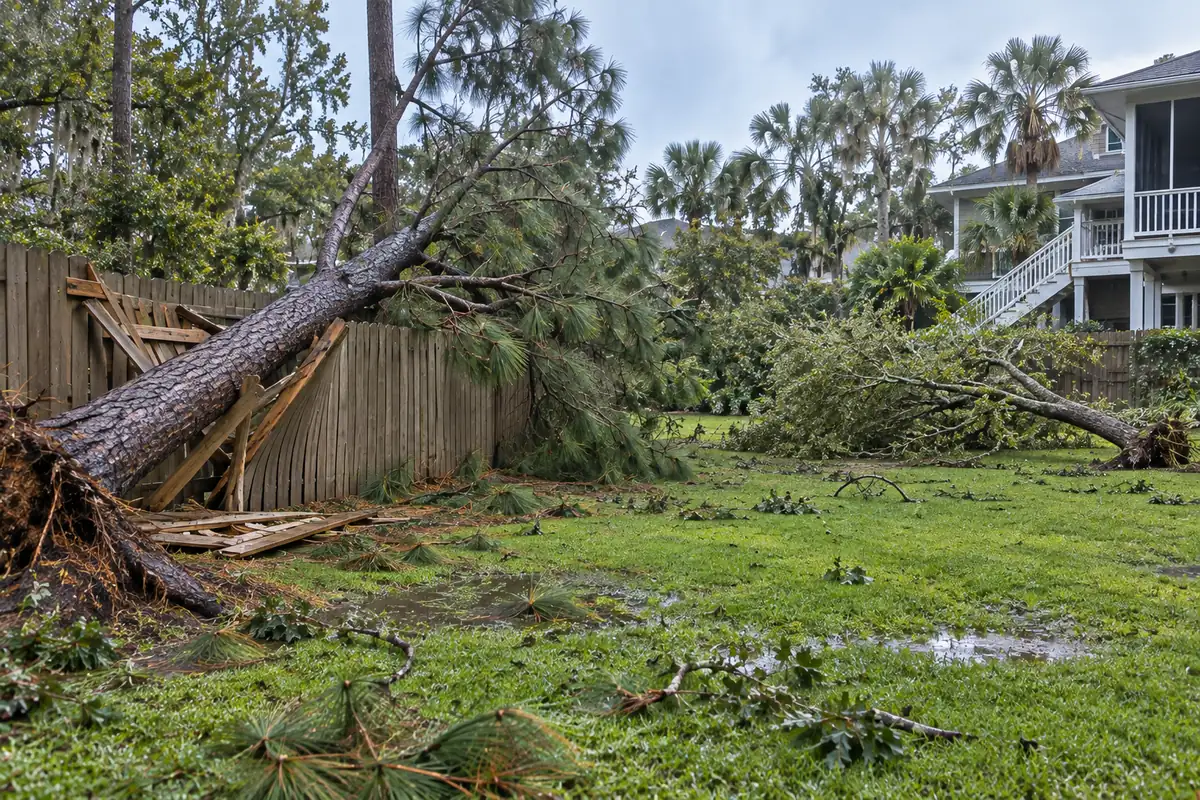
| A tree down across open lawn that hit nothing | It can wait for a quote for planned tree removal. |
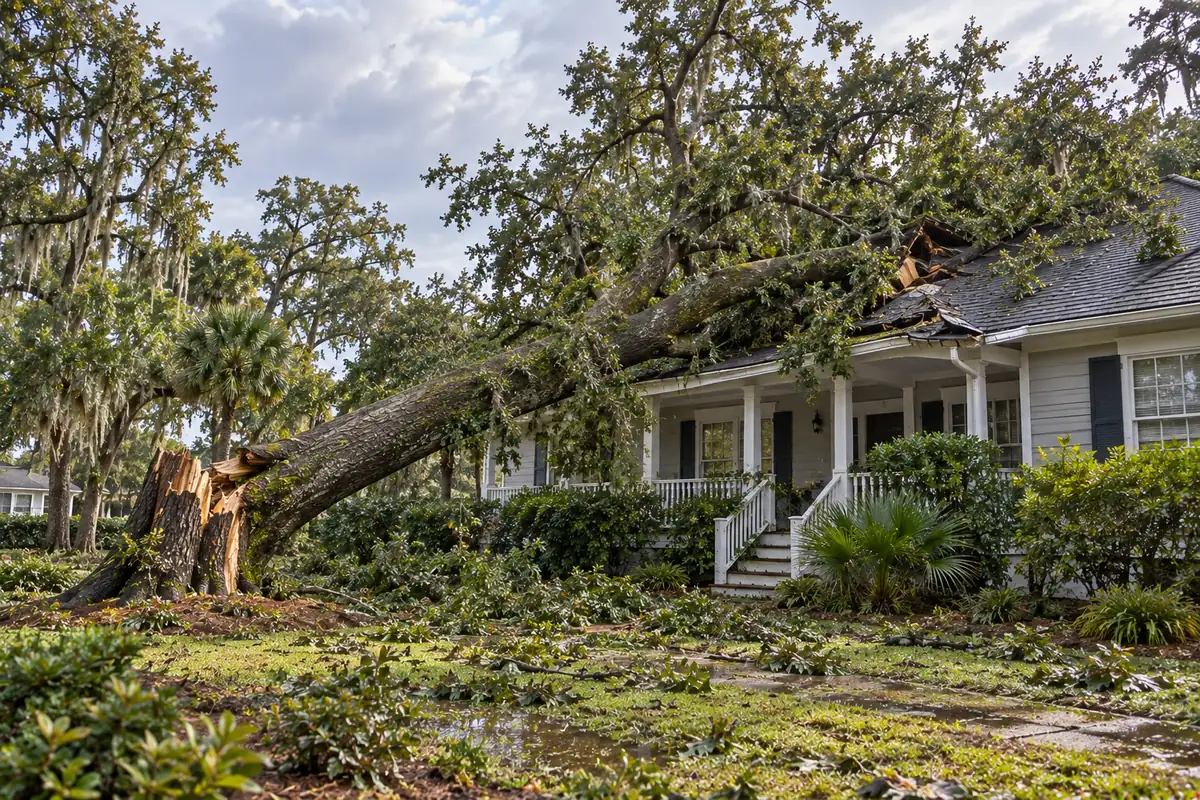
Not sure which row you are in? Take a photo of the tree from the same spot today and again tomorrow. If the lean has changed between the two photos, treat it as an emergency.
A tree is leaning toward my house. Who do I call first?
Call in this order: 911 if anyone is hurt or in danger, the power company if a line is involved, your insurer if something is damaged, and then a tree crew. If no line is involved and no one is at risk, go straight to a crew.
- 911: someone is hurt or trapped, the tree is cracking or moving toward a room people are in, or a downed line is sparking. Berkeley Electric Cooperative tells members to call 911 first for a downed line, then the co-op.
- The power company: any tree or limb on or touching a line. Dominion Energy South Carolina: 888-333-4465. Berkeley Electric Cooperative outage line: 1-855-938-3615. Your power bill shows which one serves your address.
- Your insurer: if the tree hit the house, a car or another structure. Take the photos listed below first, then call.
- A tree crew: call us and we connect you with a local, insured crew. Ask for a written estimate to send with the claim.
While you wait, move people and pets out of the rooms on the side the tree leans toward, and keep everyone out of the area it would hit. Do not cut, pull or prop the tree yourself: a loaded tree can shift when the weight changes.
What is a hazardous tree, and can it be removed before a storm?
A hazardous tree is a dead, diseased or leaning tree that could fail and hit a house, car or person. Several Charleston-area ordinances have a faster route for them, and the usual proof is a written report from an ISA Certified Arborist plus dated photos.
If a tree has already failed, that is an emergency tree service call, covered above. Which towns need a permit first, and which can waive it after a storm, is in the next section. Not sure whether the tree needs to come out? See our trimming vs. removal guide and the hurricane tree preparation checklist.
Do I need a permit for an emergency or hazard tree removal?
Often yes, but the route is faster, and in a few places a tree that is an imminent threat can come down first and be reported after. It depends on which jurisdiction your address is in, so check the lists below before a large tree is cut.
In every town, two things help: dated photos of the tree before anyone touches it, and a written report from an ISA Certified Arborist that says why it is dead, damaged or dangerous. Cutting first and documenting later is how a hazard tree becomes a violation.
Where the rules can bend after a storm
- Sullivan’s Island: a tree that is an imminent threat can be removed without prior approval; report it within 5 days.
- Folly Beach: the tree code exempts dead and fallen trees, and emergencies such as hurricanes, tornadoes and floods. Questions: permits@follybeach.gov, 843-588-2447.
- Town of James Island: in an emergency the Zoning Administrator can waive the process; a written arborist report and photos come afterward. Call (843) 795-4141.
- Unincorporated Charleston County: in a storm or flood emergency the Zoning and Planning Director can waive the process; photos and a report come afterward.
- Mount Pleasant: after a storm, Town Council can waive the rules, and fallen or badly damaged trees may be cut until Council decides otherwise. Check the Town’s notices or call (843) 884-1229.
- Moncks Corner: after a storm, the town administrator can suspend the rules for up to 30 days for fallen or badly damaged trees that pose a risk.
- North Charleston: the city says the Zoning Administrator can waive the rules for a tree that poses a severe or imminent threat, with written findings afterward. Otherwise the contractor you hire applies for the permit.
- Goose Creek: dead or storm-damaged trees with documentation are exempt. Confirm with Planning and Zoning, (843) 797-6220 ext. 1114.
Where you still apply first
- City of Charleston: trees under 24 inches on single-family and two-family lots need no permit. A hazardous, diseased or irreparably damaged grand tree is approved for removal with a qualified arborist’s documentation (Sec. 54-329(c)). We found no storm waiver; call Citizen Services, 843-724-7311.
- Summerville: a permit is issued if the tree is dead, if a certified arborist says the risk cannot be reasonably reduced, or if it is within 8 feet of the house. Staff can approve removal of a grand tree during a weather emergency, but we found no rule that skips the application. Call 843-871-6000.
- Hanahan: a permit is still needed for trees that are dead or damaged by storm or fire.
- Kiawah Island: dead or hazardous trees need prior notice to the Planning Department with photos and arborist documentation.
- Isle of Palms and Seabrook Island: we found no storm rule. Call the Isle of Palms Building Department, 843-886-9912, or Seabrook Island, (843) 768-9121.
- Unincorporated Berkeley and Dorchester counties: confirm with Planning and Zoning before you cut.
Official links for each rule are in our tree removal permit guide. If a tree is already on your house, photograph it before anything is moved: those photos are the documentation most of these rules ask for.
What to do right after a tree falls
1. Get people clear. Keep everyone, including pets, away from the tree and the area under damaged limbs. If the tree came through the roof, leave that part of the house until someone checks it.
2. Stay away from wires. Treat every downed line as energized, and stay at least 30 feet away from it and from anything it touches, including the tree, a fence or standing water.
3. Do not cut it yourself. A tree resting on a house or another tree is under tension, and a single cut can make it shift or spring back. That is work for a professional crew with rigging and, often, a crane.
4. Document the damage. Take photos and video before anything is moved. The South Carolina Department of Insurance says this evidence helps prove your loss and support your claim, and to call your agent or insurer as soon as possible (source: SC Attorney General, January 23, 2026). Photograph:
- The whole scene: wide shots from the street and the yard that show the tree and what it hit.
- Each point of damage: roof, gutters, siding, windows, the car and the fence, close up and from a few steps back.
- Inside the house: ceiling stains, leaks and broken glass.
- The trunk, the break and the base: the Department of Insurance says policies generally exclude damage from negligence or poor maintenance, so the condition of the wood can matter.
- Power lines, from a distance: never walk closer to get the shot.
- Receipts: keep every receipt for tarps, emergency work and the tree crew, as FEMA advises.
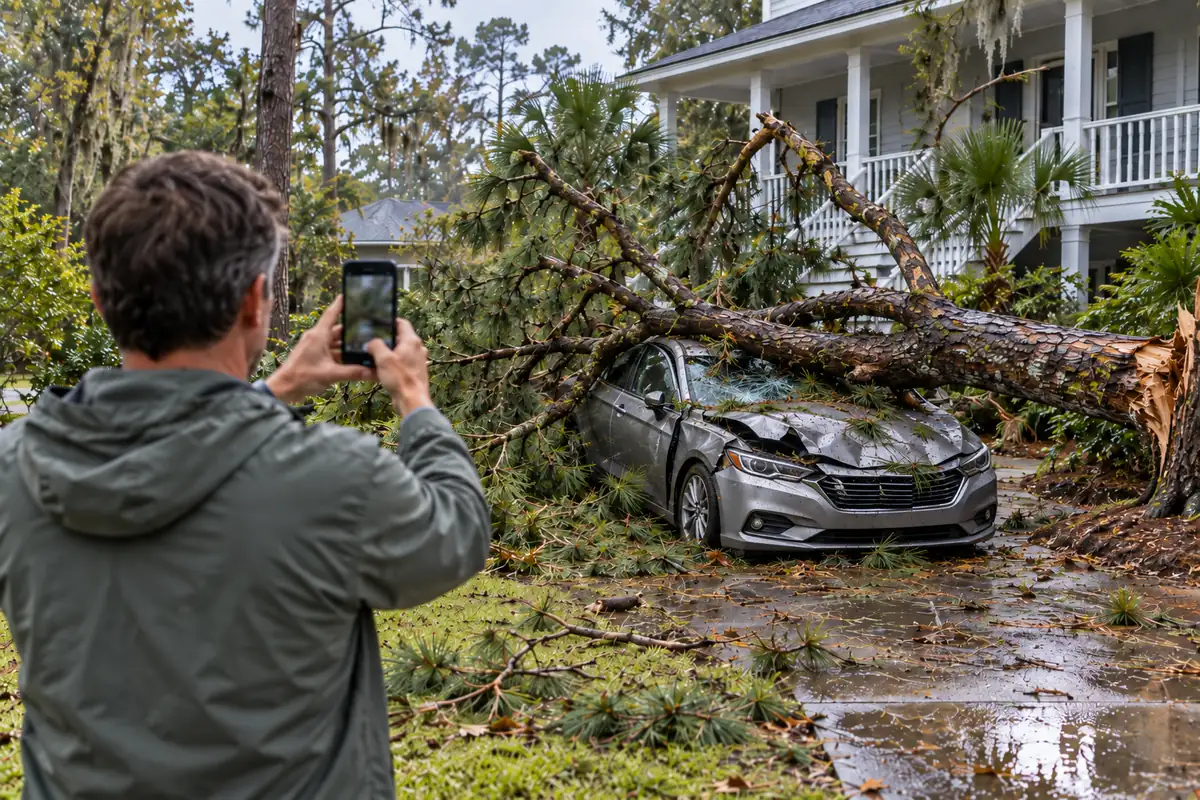
5. Call your insurer and a crew. Report the claim, then call us to reach a local crew for emergency removal and cleanup.
Who handles downed power lines?
Who to call
Only the utility can work on energized lines, and tree crews cannot start until the line is cleared. Dominion Energy South Carolina and Berkeley Electric Cooperative serve most of the Charleston area; their numbers are in the list above, and your power bill shows which one serves your address.
How far to stay away
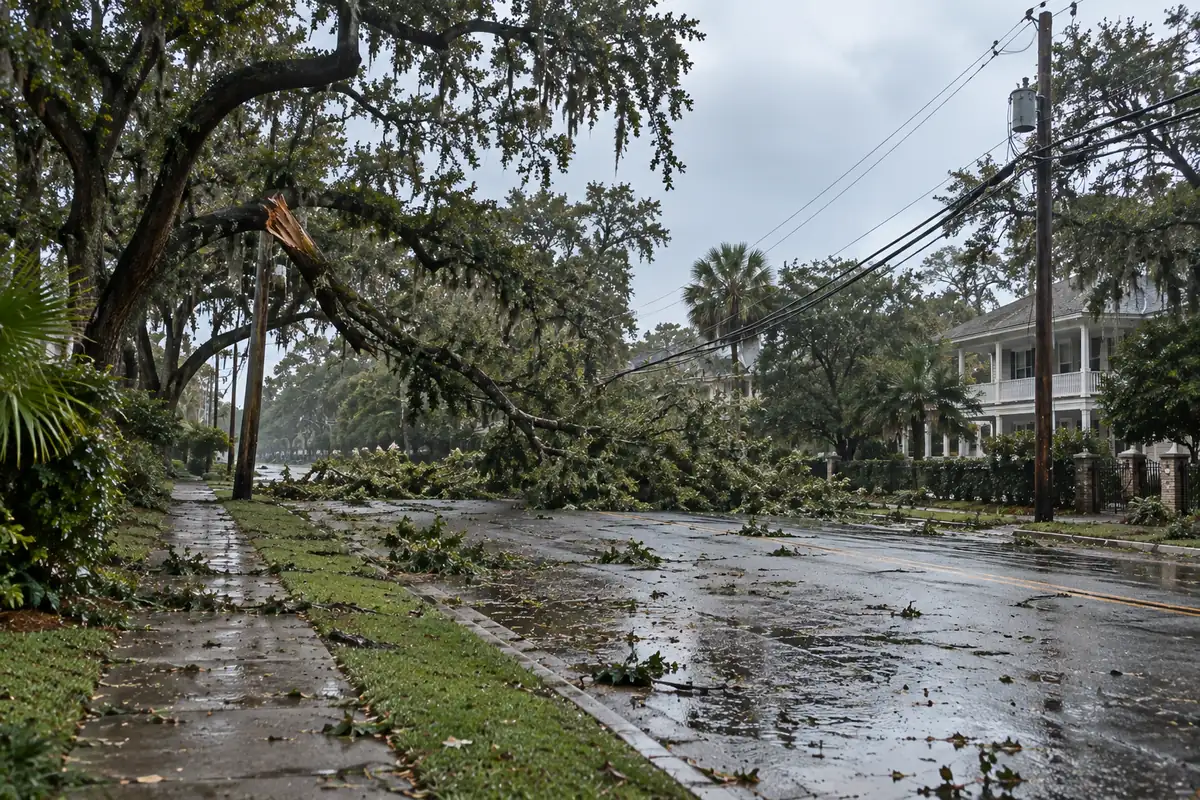
Assume every downed line is energized. Dominion says to stay at least 30 feet away (source: Dominion Energy), and Berkeley Electric says at least 20 feet (source: Berkeley Electric safety page). Use the larger number.
Does homeowners insurance cover tree removal?
When it is usually covered
According to the Insurance Information Institute, a standard homeowners policy covers the damage when a tree hits your home or another insured structure, such as a detached garage, and also covers removing that tree, generally up to about $500 to $1,000 depending on the insurer and policy.
When it is usually not covered
If the tree fell without hitting an insured structure, there is generally no coverage for removing it, although some insurers will pay when it blocks a driveway. If the tree came from a neighbor’s yard, your insurer may try to recover the cost from the neighbor’s insurer. Read your own policy and ask the crew for a written estimate to send with the claim.
How much does emergency tree removal cost?
Today’s Homeowner reports that Charleston property owners pay an average of $925 for emergency tree removal, compared with an average of $618 for standard tree removal (source: Today’s Homeowner, Charleston tree removal).
Emergency work costs more because the tree is often resting on a structure or under tension, it may need a crane, and crews are stretched thin right after a storm. Cleanup and hauling away debris may be priced separately, so ask what the quote includes before work starts, including whether grinding the stump is part of it (see the stump grinding cost guide).
The averages in that guide are for planned jobs, not storm-night work. Prices by town, with each town’s permit fee, are in our tree removal cost guide.
How much does fallen tree removal cost?
A tree that is already down costs less to remove than a standing one: LawnStarter puts fallen tree removal at $85 to $300 nationally (page updated October 5, 2026). The same page says emergency removal costs much more than a standard job, so a tree on the house is a different price from a tree in an open yard.
These are national averages, not Charleston quotes, and a tree resting on a roof or a car is not a simple fallen-tree job. Ask the crew for a written quote that says what is included; Charleston-area averages by town are in our tree removal cost guide.
How much does tree debris and branch removal cost?
Hauling away the debris is often a separate line: LawnStarter lists hauling at $50 to $90, chipping at $65 to $125 and splitting the wood at $50 to $90. Ask whether cleanup is in the quote before work starts.
- Limbs and branches: ask whether the crew removes only what fell or also the broken limbs still hanging over the roof.
- Public pickup: see the debris section above for what FEMA says about private property and local government pickup.
Hiring a crew after a storm
After a big storm, crews from out of the area arrive and knock on doors. Before anyone starts, ask for proof of liability and workers’ compensation insurance and a written estimate, and do not pay the full job up front. The same checklist is on our tree service in Charleston page. The step-by-step version, with sources, is in our checklist for hiring a tree service.
Who removes storm debris from my yard after a hurricane?
Debris on your own property is generally your responsibility. FEMA says debris removal from private property is the responsibility of the property owner and is usually not eligible for public assistance, with limited exceptions where the work benefits the wider community (source: FEMA, private property debris removal).
Public debris pickup is run by local governments. FEMA states that it does not directly handle debris removal or hire contractors; it reimburses local governments for their storm-related debris removal and tells property owners to check with their county or municipal government for guidelines (source: FEMA, debris removal rumor control). After a big storm, ask your town or Charleston County whether curbside debris collection is running and how they want branches placed, and ask the tree crew whether hauling away is included in the quote.
Rules on cutting fallen or damaged trees after a storm differ by town; see our tree removal permit guide for Charleston, SC.
Hurricane season in the Lowcountry
The Atlantic hurricane season lasts from June 1 to November 30. Dead limbs, hollow trunks and trees leaning toward the house are the hazardous ones to deal with before the season, through scheduled pruning before the next storm or removal, while crews have time to schedule the work. What to check before the season, when a storm is forecast and after it passes is in our hurricane tree preparation checklist.
Storm calls come in from Mount Pleasant, West Ashley, James Island, North Charleston and Summerville, and from the beaches, Isle of Palms to Folly Beach, and we route each one to a crew that works nearby. See all service areas.
Frequently asked questions
Can a crew come the same day?
Often, yes, but it depends on how many calls come in after a storm. A tree on a house or blocking the only exit is handled first. Call as early as possible.
A tree is leaning toward my house. Is it an emergency?
It is if the lean is new or got worse after a storm, or if the soil at the base is cracked or lifting, because that points to root or trunk failure. A tree that has leaned the same way for years can usually wait for a scheduled quote. If it touches a power line, call the power company first; if anyone is in danger, call 911.
Do I need a permit to remove a dangerous tree after a storm?
It depends on the town. Sullivan’s Island lets you remove an imminent threat and report it within 5 days, and several towns can waive their rules after a storm, but Hanahan, Summerville and the City of Charleston (for grand trees) still expect an application or documentation first. Photograph the tree before anything is moved and get an arborist’s written report when you can.
The tree came from my neighbor’s yard. Who pays?
If it hit your house or another insured structure, file the claim with your own insurer. Your insurer may then try to recover the cost from the neighbor’s insurer, especially if the tree was in poor condition.
Can a crew come at night or on a weekend?
It depends on the crew. Some local companies answer around the clock and some do not, so after hours or during a big storm a crew may not be able to come until the next day. If anyone is in danger, call 911.
Does emergency tree removal need a crane?
Sometimes. A tree resting on a house or under tension may need one, but we found no reliable published crane price, so ask the crew whether one is needed and what it adds to the written quote.
How much does it cost to remove a fallen tree?
LawnStarter puts fallen tree removal at $85 to $300 nationally, and says emergency removal costs much more. A tree on a roof or car is priced differently, so get a written quote.