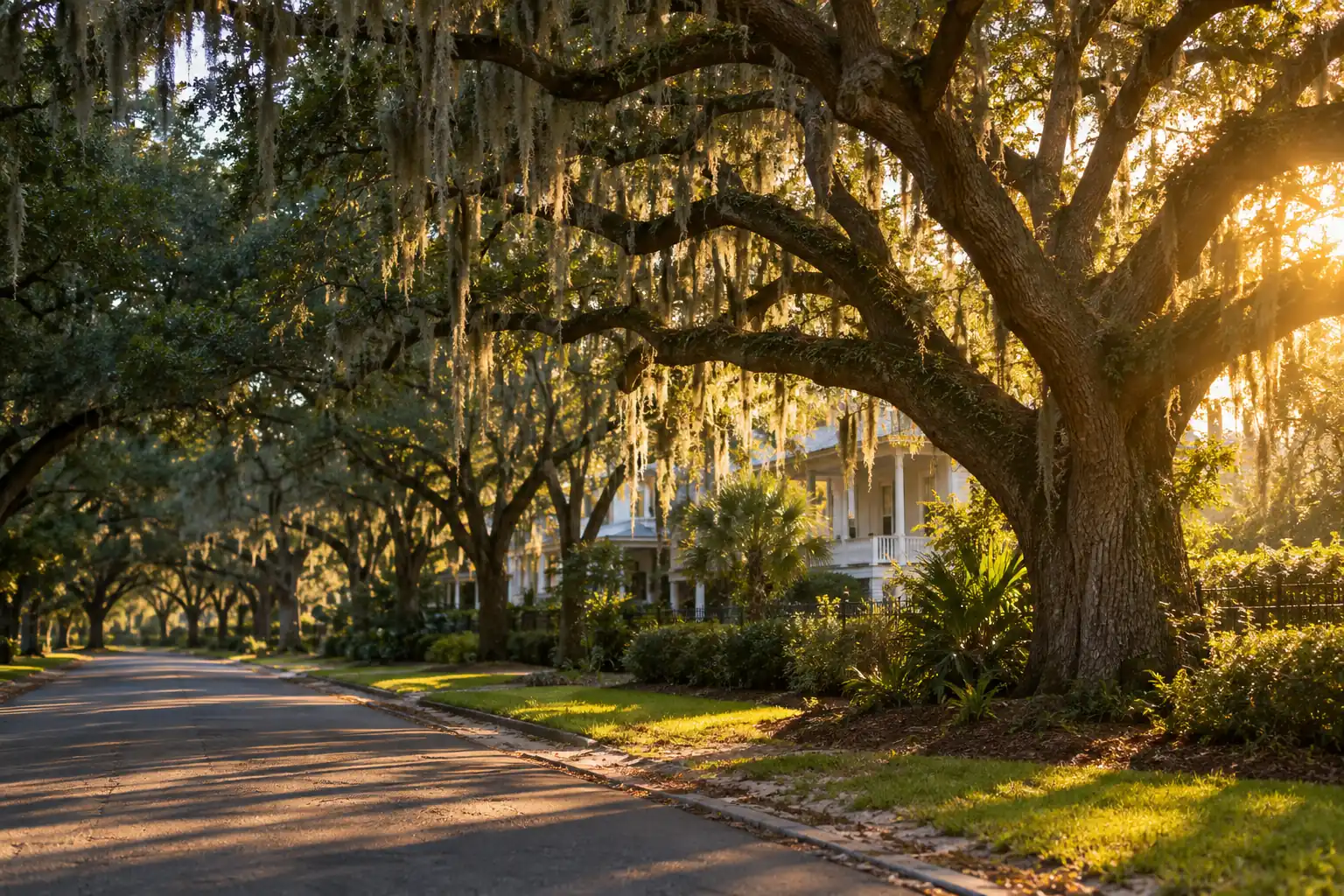
What is the difference between tree trimming and tree removal?
Trimming (also called pruning) cuts off parts of a tree: dead limbs, weak limbs, branches over a roof or a driveway. The tree stays. Removal takes down the whole tree, usually followed by stump grinding or leaving a stump. Clemson Extension uses the word “pruning” for the work; in everyday talk, and in this guide, trimming and pruning mean the same thing.
The real question is where the problem is. A problem in a limb can be cut out. A problem in the trunk or the root system cannot, because the tree needs those parts to stand. That is the line the rest of this guide follows.
Should you trim or remove it? A quick decision table
Use this as a starting point, not a verdict. The thresholds come from the University of Maryland Extension, whose guidance says “probably” for most of them; a certified arborist should confirm any tree that could hit a house or a person.
| What you see | Usually | Source |
|---|---|---|
| Dead or weak limbs, but trunk and roots look sound | Trim | Clemson HGIC |
| Less than 25% of the branches damaged | Trim; the tree will probably survive | UMD Extension |
| Trunk wound covering less than 25% of the circumference | Watch; it may heal | UMD Extension |
| About one-third of the trunk hollow or rotten | Remove (probably) | UMD Extension |
| Lean of more than 15% from vertical | Remove (probably) | UMD Extension |
| A sudden new lean | Remove at once; it suggests root or trunk failure | UMD Extension |
| About half of the tree, or half of the roots, damaged | Remove (probably) | UMD Extension |
Anything in the “remove” rows that stands near a house, a driveway or a power line is a job for a professional. See tree removal or, for a tree that is already down or about to fall, emergency tree removal.
When is trimming enough?
Trimming is the right call when the problem is in the limbs and the trunk and roots are sound. Typical cases: dead or broken limbs, branches rubbing the roof or hanging over a driveway, a crowded crown, and structural pruning on a young tree. The University of Maryland Extension says that if less than 25% of a tree’s branches are damaged, it will probably survive.
Trimming also fits a tree that looks bad but is not finished. The Arbor Day Foundation notes that a tree that looks dead may only be dormant, or may have only some dead branches, and that a dying tree “could take years” to fully pass, staying sturdy in the meantime. Check before you cut it down (see the scratch test below). For care of live oaks and palmettos, see our Charleston tree care guide.
Clemson says extensive thinning of major limbs is best done by a professional arborist (Clemson HGIC 1003). To see what trimming costs here, jump to the price section or read tree trimming.
What are the signs a tree needs to come down?
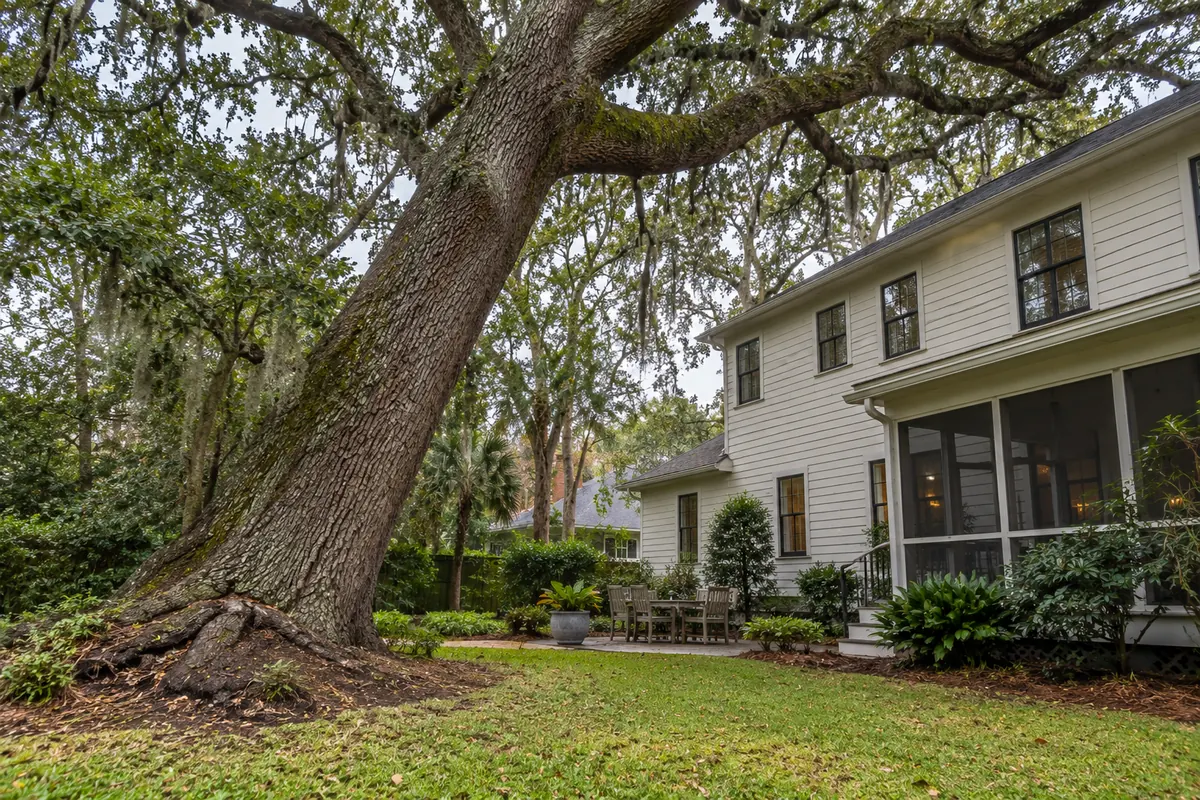
The University of Maryland Extension (revised January 2018, page updated May 18, 2023) describes these as the cases where removal is probably advised:
- A hollow or rotten trunk. When about one-third of the interior is hollow or rotten.
- A lean. More than 15% from vertical. A sudden lean points to root or trunk failure and calls for immediate removal.
- Severe trunk damage. A wound over less than 25% of the circumference may heal; bigger damage often does not.
- Half the tree gone. If about 50% of the tree, or of its root system, is damaged.
- Soil piled on the roots. Three inches or more over the roots will probably kill the tree.
The same page says a dying tree in a natural area that threatens no one can stay as a wildlife snag, and that a tree with structural defects near people or property needs prompt evaluation by a certified arborist. It also says large trees should be at least 20 feet from a house. That is Maryland guidance, not a South Carolina rule, but the logic of distance and defects carries over.
How can you tell if a tree is dead or just dormant?
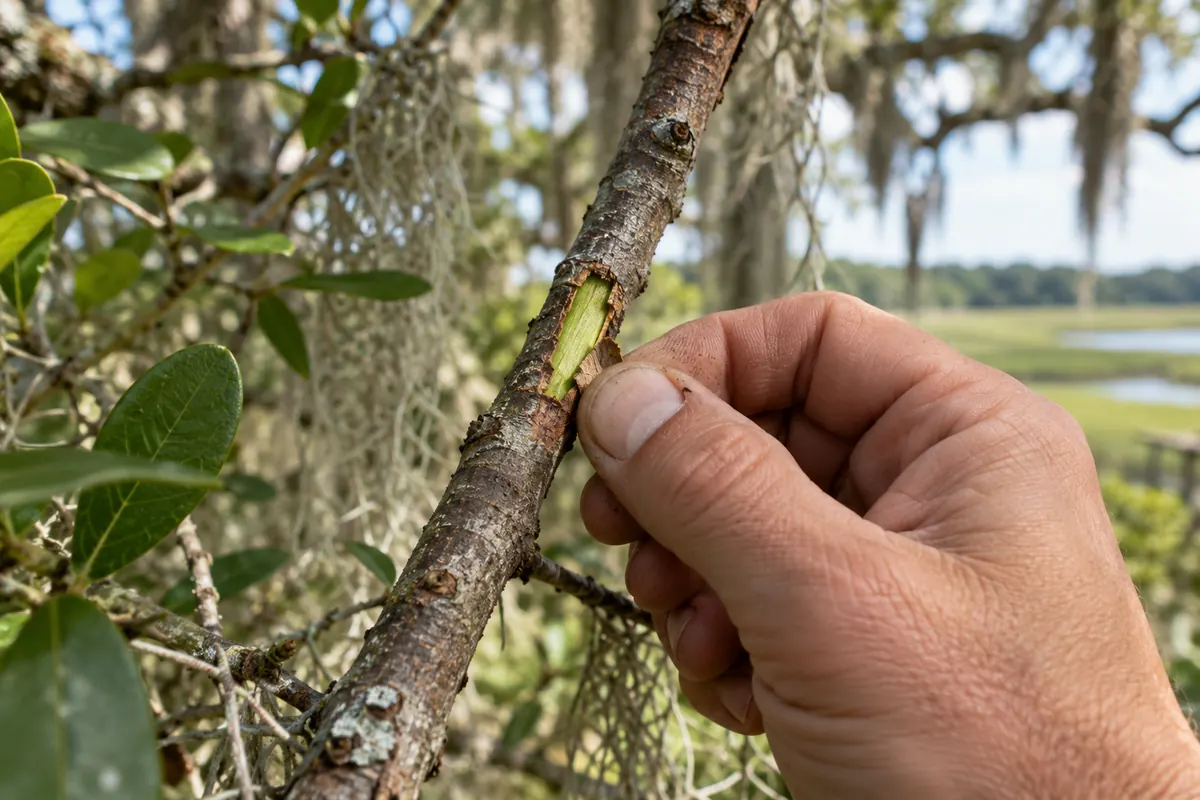
Do the scratch test before you decide. The Arbor Day Foundation (article by Jon Behm, republished February 26, 2019) calls it the easiest method: scratch a small piece of bark off a twig or branch and look for green tissue underneath. Green means the branch is alive. Test several branches, because only part of the tree may be dead.
The same article says moss on the bark is usually harmless and lichen “is not a sign that the tree is dead.” Signs that are worth a closer look: fungus near the base, roots growing along the soil surface, and shoots sprouting from the base of the trunk, which can mean stress.
If you are unsure, do not cut yet: have a certified arborist look at it and run the scratch test with them.
When is trimming the wrong fix?
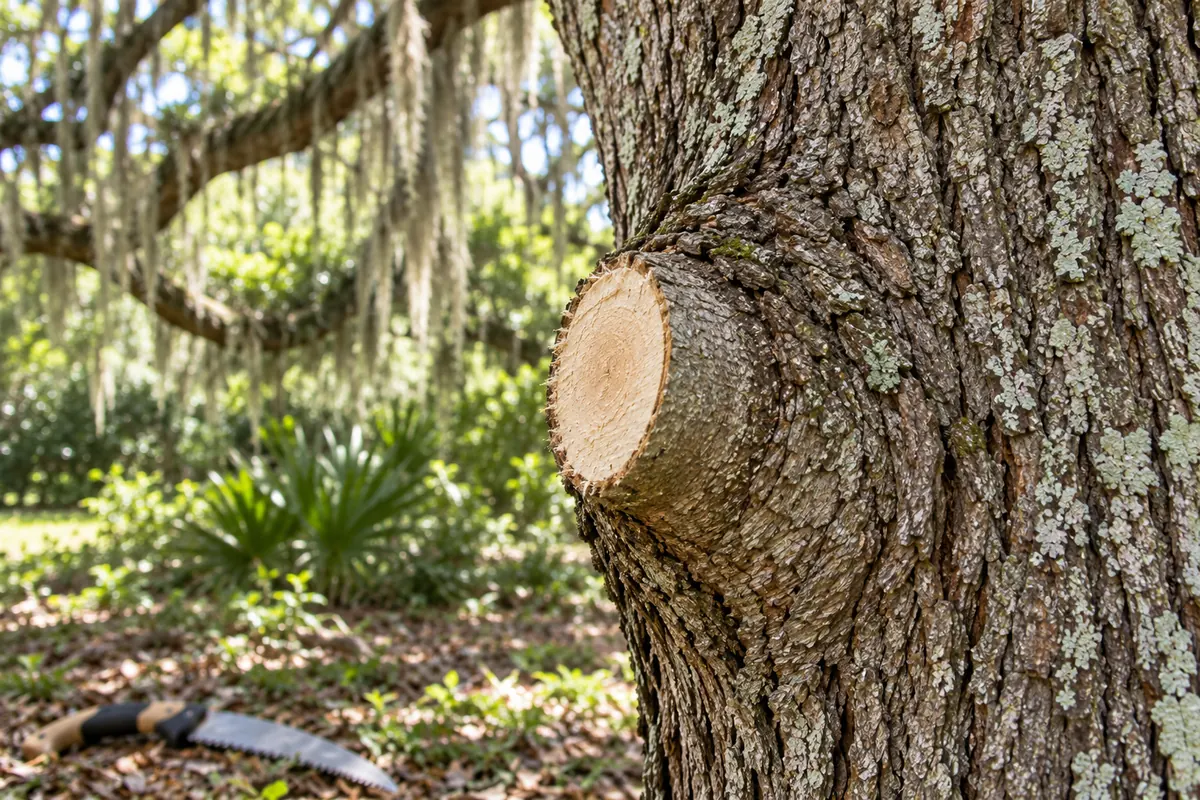
Trimming cannot save a tree whose trunk or roots are failing, and bad trimming can make a tree worse. Clemson says heading back, or “stubbing,” is rarely warranted and often produces multiple weak leaders, and warns: “Never hat-rack a landscape tree by cutting all of its branches back to an arbitrary length.” It also says the final cut should end just outside the branch collar, and that flush cuts leave large wounds that can lead to decay (Clemson HGIC 1003).
So “topping” a leaning or hollow tree to make it lighter is not a middle option. It does not fix the defect and adds new weak growth. When the defect is in the trunk or roots, the choice is between removal and a certified arborist’s written plan.
What does it cost to trim vs. remove a tree in Charleston?
LawnStarter publishes average prices for Charleston, SC, by job size (page dated October 15, 2026). These are averages, not quotes; your tree, access and cleanup change the price.
| Job size | Tree trimming | Tree removal |
|---|---|---|
| Small | $113 | $375 |
| Medium | $396 | $808 |
| Large | $760 | $1,862 |
LawnStarter lists stump grinding separately, at an average of $223. Trimming prices by town, height and species are in our tree trimming cost guide. For the full picture by town, see our tree removal cost guide.
Cost should not decide a safety call. A tree that could fall on a house is the expensive tree to leave up.
Do you need a permit to trim or remove a tree?
Often not to trim, often yes to remove, and it depends on the town. The City of Charleston says a permit is not required to prune a Grand or Protected tree, but the pruning must be done by a qualified tree service following the National Arborist Association’s Pruning Standards for Shade Trees. A Grand Tree is one 24 inches or more in diameter at 4.5 feet (pines and sweetgums excluded). For removal, the City says trees under 24 inches on single-family and duplex lots do not need a removal permit, and hazardous, diseased or irreparably injured Protected and Grand Trees can be approved for removal, with arborist documentation if the Zoning Administrator asks for it.
Other towns set different limits, and heavy pruning can count as removal in some of them. Check the town rule first: our permit guide lists Charleston, Mount Pleasant, North Charleston, Summerville and more, including the dead, dying or dangerous trees section.
What if the tree is near a power line?
Do not trim it and do not hire a crew on your own. Santee Cooper says: “Never try to trim around a power line yourself even if it is on your property.” For a service line to your house, Santee Cooper customers can call 800-804-7424 at least a day ahead to have power disconnected while a crew trims, with no fee. If your power comes from another utility, call that utility instead.
More on power lines, SC811 and checking a crew’s insurance is in the permit guide. To vet a crew step by step, use our checklist for hiring a tree service.
How do you get a second opinion before cutting?
Ask for the assessment in writing. For any tree that could reach a house, a car or a power line:
- Ask a certified arborist what is wrong (limb, trunk or roots) and whether trimming fixes it.
- Ask for a written quote that says which cuts will be made, or which tree will come down, and whether haul-away and stump grinding are included.
- Take dated photos before any work starts. They help with permits and with insurance later.
- Ask the town whether a permit is needed before a removal.
We connect you with independent, insured local pros (how it works); the quote is free and there is no obligation. Not sure which service you need? Describe the tree in the form and say so.
Sources
Every fact above comes from one of these pages, read October 15, 2026. We do not add our own estimates. This site is a referral service, not an arborist or a government office: have a qualified professional (a certified arborist) assess any specific tree, and confirm permit rules with your town. The University of Maryland and Arbor Day pages are general guidance, not South Carolina law.
- University of Maryland Extension: How Do You Decide When to Remove a Tree? (Virginia Williams; revised January 2018 by Debra Ricigliano; page updated May 18, 2023)
- Arbor Day Foundation: When to Cut Down a Tree (Jon Behm, republished February 26, 2019)
- Clemson HGIC: Principles & Practices for Pruning Trees (HGIC 1003) (revised October 3, 2019)
- City of Charleston: Tree Removal Information
- Santee Cooper: Residential tree trimming
- LawnStarter: Charleston, SC tree care prices (October 15, 2026)
Frequently asked questions
Is it cheaper to trim a tree or remove it?
Trimming, at each size LawnStarter lists for Charleston: averages of $113, $396 and $760 for trimming versus $375, $808 and $1,862 for removal (small, medium, large). These are averages, not quotes.
How do I know if a tree should be trimmed or removed?
Look at where the problem is. Dead or weak limbs on a sound tree can be trimmed. The University of Maryland Extension says removal is probably advised when about one-third of the trunk is hollow, the lean is over 15% from vertical, or about half the tree or its roots are damaged. A certified arborist should confirm any tree near a house.
Can a dying tree be saved?
Sometimes. The University of Maryland Extension says a tree with less than 25% of its branches damaged will probably survive, while one with about half damaged probably should come down. The Arbor Day Foundation adds that a dying tree can take years to fail. Have a certified arborist look before deciding.
How do I tell if a tree is dead or dormant?
Scratch a bit of bark off a small branch. Green tissue underneath means it is alive. Test several branches, since only part of a tree may be dead (Arbor Day Foundation).
Do I need a permit to trim a tree in Charleston?
The City of Charleston says no permit is required to prune a Grand or Protected tree, but the work must be done by a qualified tree service following pruning standards. Removal rules depend on the tree size and the town, so check before cutting.
Can I trim a tree that touches a power line?
No. Santee Cooper says never to trim around a power line yourself, even on your own property. Call your utility first.