What makes tree care different in Charleston?
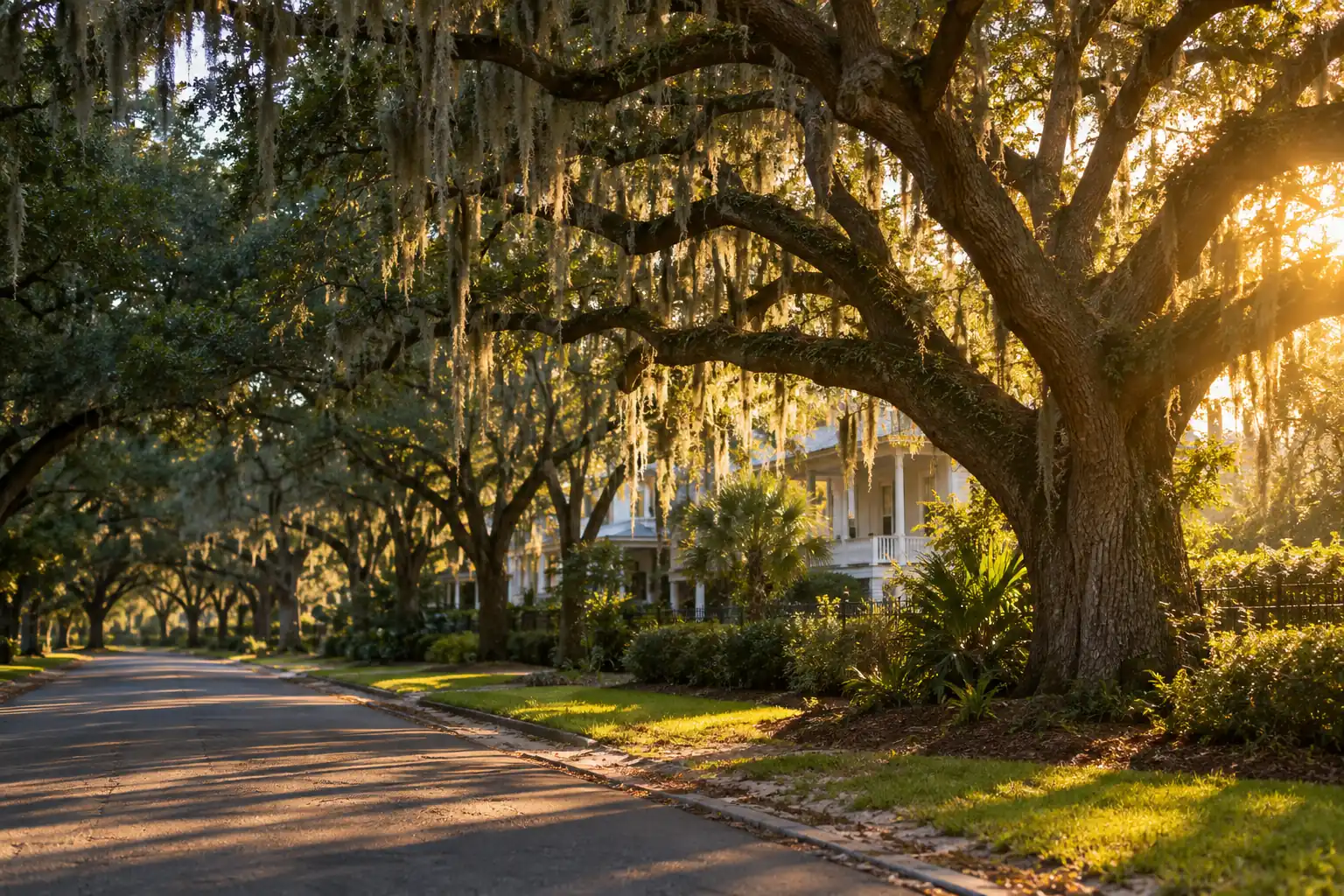
Salt, sandy soil, hurricanes and mild winters. Clemson’s live oak fact sheet rates the tree for USDA zones 8 to 10, says it grows best in well-drained sandy soil but tolerates drier, compacted soil, and says its waxy leaves are resistant to salt spray. Clemson also says the sabal palmetto, South Carolina’s state tree, is very tolerant of salt spray.
Both trees are well suited to the coast. Most problems come from what happens around the tree rather than from the climate: pruning, digging, paving and fill. For wind and storm planning, see our hurricane tree preparation checklist.
How big do live oaks get, and how long do they live?
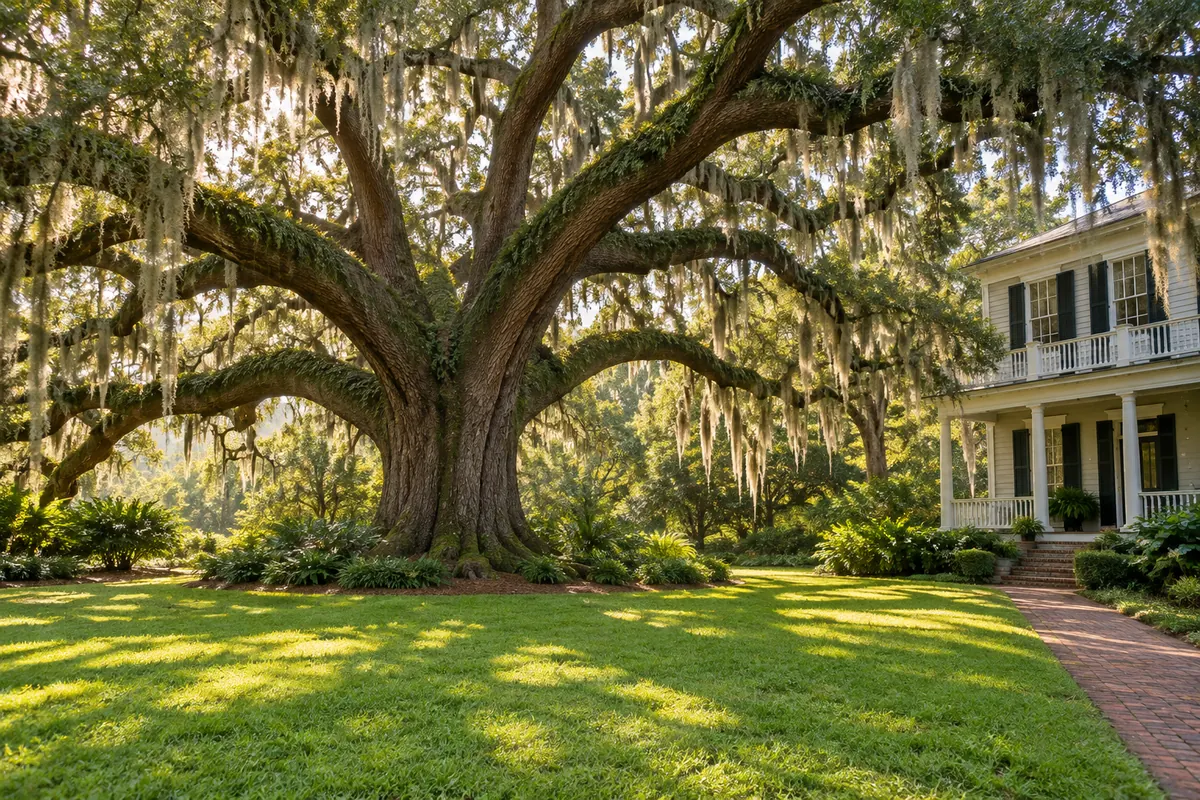
Bigger than most lots are planned for. Two extension sources give slightly different ranges, so here are both:
| Clemson HGIC 1014 | UF/IFAS ENH-722 | |
|---|---|---|
| Height | about 40 to 80 ft | 60 to 80 ft |
| Spread | about 60 to 100 ft | 60 to 120 ft |
| Trunk | can exceed 6 ft across | can exceed 6 ft across |
| Growth | up to 2 to 2½ ft a year when young, slower with age | about 3 ft a year when young |
| Lifespan | some live 200 to 300 years | “centuries” if properly located and cared for |
Sources: Clemson HGIC 1014 (revised June 29, 2020) and UF/IFAS ENH-722 (revised December 2018). UF/IFAS adds that the tree can form large surface roots that, in time, lift sidewalks, curbs and driveways, which Clemson also notes for streets and sidewalks planted too close.
How and when should you prune a live oak?
Lightly, early in its life, and in summer. Clemson says to prune a live oak only as needed to build strong structure while it is young, to train a central leader by removing young multiple trunks and branches, and to prune in mid-to-late summer to avoid spreading oak wilt. UF/IFAS agrees that structure matters: it says pruning is needed for strong structure, suggests pruning yearly for the first three years after planting and then every five years to age 30, and calls a lack of pruning one of the biggest problems with live oak in cities.
What to avoid: topping. Clemson says never to “hat-rack” a landscape tree by cutting all of its branches back to an arbitrary length, and says that practice has no place in horticulture and often kills the tree. It also says the final cut should end just outside the branch collar, and that flush cuts create larger wounds that can lead to decay (Clemson HGIC 1003). Opening up a big crown by thinning back to major limbs is, in Clemson’s words, a specialized technique best performed by a professional arborist.
Big limbs over a roof or a driveway are a job for a crew, not a ladder. See tree trimming, and the trimming vs. removal guide if you are not sure the tree can be saved.
Is Spanish moss killing your oak?
Almost certainly not. The Clemson fact sheet on Spanish moss says it “causes little to no detrimental effect on a host tree,” because it is an epiphyte that takes no water or nutrients from the tree and uses it only for support.
Two cautions from the same page. Heavy growth can shade out the lower leaves, and the moss is most common on trees that are already declining for some other reason. Clemson says to improve the tree’s health with watering and fertilizing rather than blaming the moss, and notes there are no chemical treatments for it. So if an oak is thin and covered in moss, look at the roots, the soil and the trunk first.
How do you protect live oak roots?
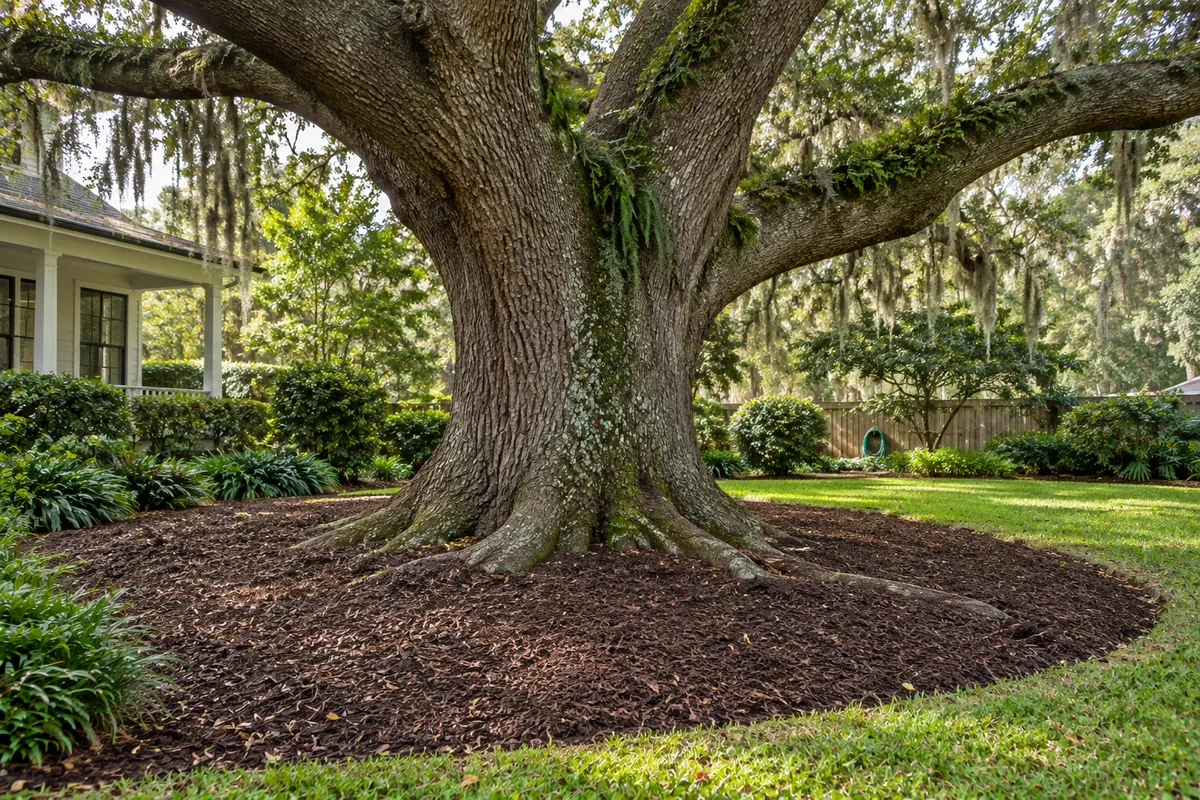
Keep machines, fill and paving away from them. Clemson’s oak fact sheet names the key strategy as maintaining tree health through proper watering, mulching, fertilization and “protection from root and construction damage.” Its specifics: protect trees during construction and utility repairs, water about 1 inch a week in a summer drought, and mulch 3 inches deep from the trunk out to the dripline, keeping the mulch off the trunk (Clemson HGIC, oak diseases, updated February 13, 2026).
UF/IFAS adds a warning sign: trees hurt by construction take a long time to die, and live oak is usually the last tree to die around a newly built building, so decline can show up years after the damage.
If the oak is a Grand Tree inside the City of Charleston, the City requires a protective zone kept free of land disturbance, paving, fill, vehicles and heavy machinery, with a physical barrier at least 4 feet tall. The minimum clearance is 12 feet from the base for a 24-inch tree, plus 1 foot for every 3 inches over 24. A 36-inch tree, for example, needs 16 feet.
What problems affect live oaks here?
Mostly minor ones. Clemson lists these for live oak:
- Leaf blister. A fungal gall that disfigures leaves and causes some leaf drop, without appreciable harm. Raking up fallen leaves reduces the severity the next year.
- Insect galls. A minor problem that usually needs no control.
- Oak wilt. A serious fungal disease that can kill infected oaks within a year or two. Clemson’s live oak fact sheet lists six South Carolina counties where it occurs (Chesterfield, Kershaw, Lancaster, Lee, Darlington and Barnwell). Charleston is not on that list, but lists change.
- Armillaria root rot. Honey-colored mushrooms in clusters at the root collar or spreading along major roots, most visible in wet weather, with slow decline most noticeable in late summer and fall (Clemson, oak diseases).
Several of these look alike from the street. Have a certified arborist or your county Clemson Extension office look at an oak that is thinning, dropping limbs or growing mushrooms at the base. If a tree turns out to be beyond saving, see tree removal.
How do you care for a sabal palmetto?
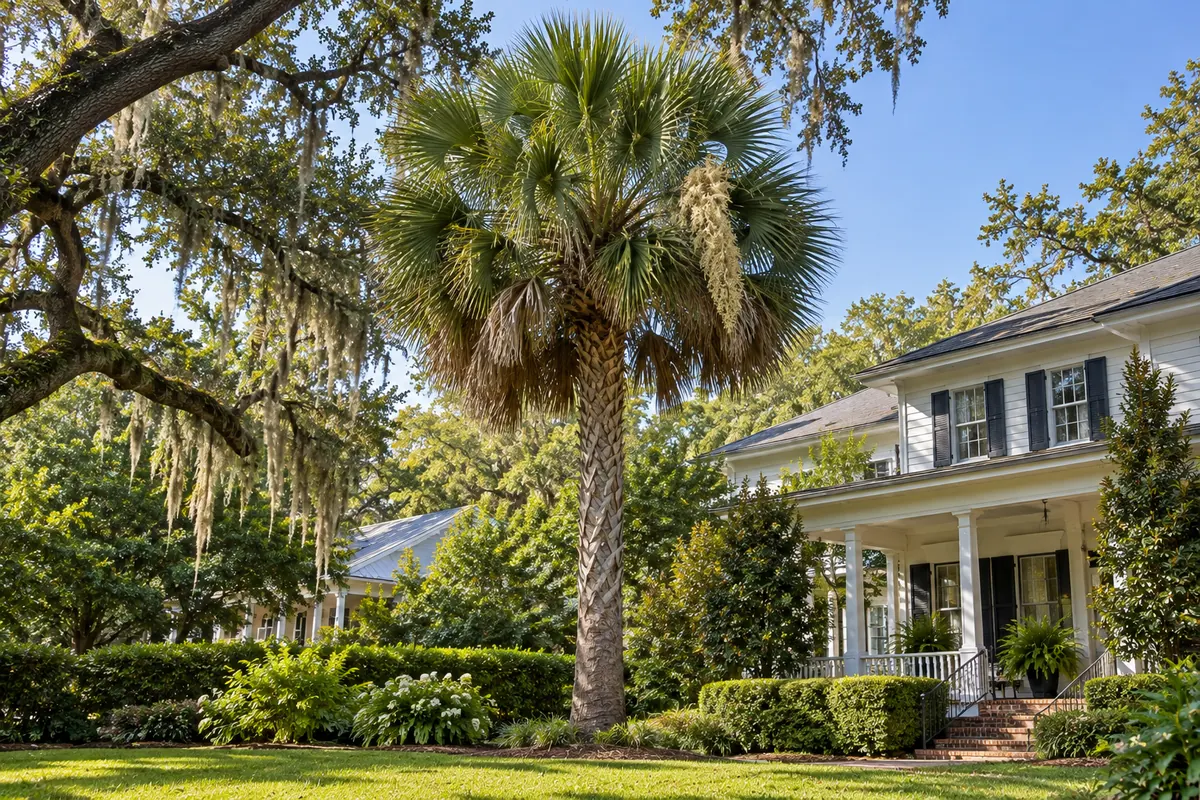
Clemson calls the cabbage palm (sabal palmetto) the state tree of South Carolina, says a mature height of 30 feet is common in the area, and says it does best in full sun to light shade and sandy soil, with ample water. Care is mostly about restraint:
- Prune only what is dead. Clemson says to remove only completely dead and loose leaves, badly damaged or diseased leaves and fruit, and flower stalks. If the leaf stem is green, the leaf is not dead. Never remove leaves above the horizontal (the 9:00 and 3:00 positions), which leaves a “lion’s tail” look, and do not cut into the trunk.
- No “hurricane cut.” UF/IFAS reports that palms with most of their leaves removed were more likely to have their crowns snapped off in the 2004 and 2005 hurricane seasons. It also says overpruned sabal palms develop tapered trunks (UF/IFAS EP443, reviewed April 2020).
- Protect the trunk. UF/IFAS says never to use climbing spikes, because the wounds never heal, and never to cut into the trunk or pull leaves that resist, since wounds let trunk rot in.
- Fertilize in season. Clemson’s general palm advice is to fertilize between April 1 and August 1, with granular fertilizer not applied after August 1.
- Moving one is hard. Clemson says a sabal must regenerate all new roots from the trunk, so moving a large one is a specialist job. Plant no deeper than the original grade.
For the hurricane-season side of palm pruning, see the palmetto section of our hurricane checklist.
How much does palm tree removal cost, and do you need a permit?
LawnStarter lists an average palm tree removal price of $725 nationally (page updated October 5, 2026), against $775 for an oak and $925 for a pine. That is a national average, not a Charleston quote; a palm's height and access change the price like any other tree's.
- Trimming instead: LawnStarter lists palm trimming at $100 to $1,330 per tree. See the tree trimming cost guide, and remember that only dead fronds should come off a healthy palm.
- Permits: some Charleston-area towns protect palms. Isle of Palms covers trees of 8 inches or more, including palms, and Sullivan’s Island protects palmettos; both require a permit before removal. Rules for every town are in the permit guide.
- The stump: we found no reliable source on palm stumps, so ask the crew whether grinding is included. Prices are in the stump grinding cost guide.
For a quote on a palm that has died or is leaning, request a tree removal quote.
What local rules apply to oaks and palmettos?
Inside the City of Charleston, size drives the rules. The City defines a Grand Tree as any tree 24 inches or more in diameter at 4.5 feet (pines and sweetgums excluded), and a Protected Tree as 8 inches or more (except multi-stem crepe myrtles). A permit is not required to prune a Grand or Protected tree, but the pruning must be done by a qualified tree service following the National Arborist Association’s Pruning Standards for Shade Trees.
Removal is different: trees under 24 inches on single-family and duplex lots do not need a removal permit, and hazardous, diseased or irreparably injured trees can be approved, with arborist documentation if the Zoning Administrator asks. Other towns have their own limits. Check the permit guide for your town before any cutting.
What about oaks and palms near power lines?
Leave that to the utility. Santee Cooper says: “Never try to trim around a power line yourself even if it is on your property.” For a service line to your house, its customers can call 800-804-7424 at least a day ahead to have power disconnected while a crew trims, with no fee. If another utility serves you, call that one.
More on power lines and SC811 is in the permit guide. To choose a crew, use our checklist for hiring a tree service.
When should you call a professional?
Call before a problem is an emergency. Good reasons: big limbs over the house, a lean that is new, mushrooms at the base, a thinning crown, work near wires, or any pruning on a protected tree.
- Ask for a written quote that says which cuts will be made.
- Do not accept topping or “lion-tailing” of a palm.
- Ask whether the town needs a permit.
- Take dated photos before work starts.
We connect you with independent, insured local pros (how it works); the quote is free and there is no obligation. To plan for what it costs, see the tree cost guide.
Sources
Every fact above comes from one of these pages, read October 15, 2026. We do not add our own estimates. This guide has not been reviewed by an arborist; it is a referral site’s summary of the sources below. Have a certified arborist assess any specific tree, and confirm local rules with your town. University of Florida pages describe Florida conditions and are used only where Clemson is silent.
- Clemson HGIC: Live Oak (HGIC 1014) (revised June 29, 2020)
- Clemson HGIC: Oak Diseases (updated February 13, 2026)
- Clemson HGIC: Palms and Cycads (HGIC 1019) (revised December 1, 2007)
- Clemson HGIC: Spanish Moss, Lichens and Slime Molds (HGIC 2354) (updated November 13, 2013)
- Clemson HGIC: Principles & Practices for Pruning Trees (HGIC 1003) (revised October 3, 2019)
- UF/IFAS: Southern Live Oak (ENH-722) (revised December 2018)
- UF/IFAS: Pruning Palms (EP443) (Timothy K. Broschat; reviewed April 2020)
- City of Charleston: Tree Removal Information
- Santee Cooper: Residential tree trimming
Frequently asked questions
When should you prune a live oak in South Carolina?
Clemson Extension says to prune live oaks in mid-to-late summer to avoid spreading oak wilt, and only as needed: build strong structure while the tree is young and avoid topping.
Does Spanish moss kill live oak trees?
No. Clemson says Spanish moss causes little to no detrimental effect on a host tree. It is an epiphyte that takes no water or nutrients. Heavy growth can shade lower leaves, and it is most common on trees already declining for another reason.
Should you cut the fronds off a sabal palmetto?
Only dead ones. Clemson says to remove only completely dead and loose leaves, badly damaged or diseased leaves, and flower stalks, and never leaves above the 9:00 and 3:00 positions. UF/IFAS reports hurricane-cut palms were more likely to lose their crowns in the 2004 and 2005 storms.
How do you protect a live oak during construction?
Keep machines, fill and paving off the root zone. Clemson names protection from root and construction damage as a key strategy. In the City of Charleston, a Grand Tree needs a barricaded protective zone starting 12 feet from the base for a 24-inch tree, plus 1 foot per 3 inches over 24.
Do you need a permit to prune a live oak in Charleston?
The City of Charleston says no permit is required to prune a Grand or Protected tree, but the work must be done by a qualified tree service following the National Arborist Association pruning standards. Removal rules depend on the size and the town.
Is oak wilt a problem for live oaks in Charleston?
Clemson calls oak wilt serious and lists six SC counties where it occurs; Charleston County is not among them. Lists can change, so have a certified arborist or Clemson Extension check any oak that declines quickly.
How much does palm tree removal cost?
LawnStarter lists an average palm tree removal price of $725 nationally, and palm trimming at $100 to $1,330 per tree. The reliable number for your palm is a written quote after a crew sees it.
Do you need a permit to remove a palmetto?
It depends on the town. Sullivan's Island protects palmettos and Isle of Palms covers trees of 8 inches or more, including palms; both require a permit before removal. Check the permit guide for your town.