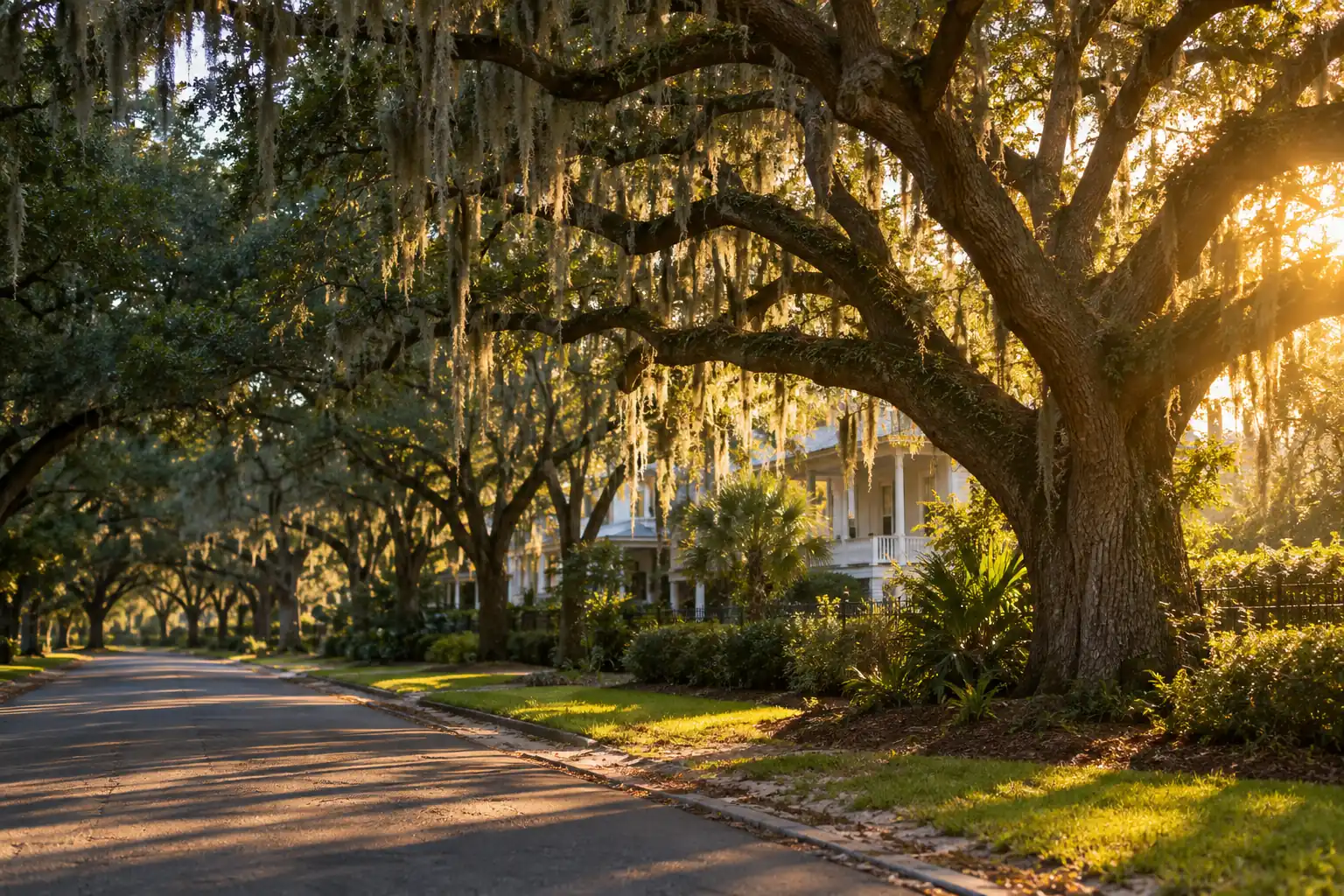
When should you get your trees ready for hurricane season?
Before June 1, and again before the peak. The National Hurricane Center says the Atlantic season runs from June 1 to November 30, peaks on September 10, and is most active from mid-August to mid-October. Pruning, cabling or removing a weak tree takes planning, and a storm in the forecast leaves little time, so the useful work happens in the calm months.
Clemson Extension advises inspecting trees for defects at least twice a year (Clemson News). A simple schedule for Charleston: one walk-around in late winter or spring, before the season starts, and a second one in mid-summer, before the peak.
The hurricane tree checklist
Before the season (spring)
- Note which trees could reach your house, garage, driveway or a power line if they fell. Clemson calls these trees “within striking distance” and says they need regular checks.
- Look at each of those trees for the warning signs listed below: cavities, cracks, peeling bark, bore holes, rotten pruning wounds, dead limbs.
- Look for two trunks of similar size joined in a tight V. Clemson says these co-dominant stems can trap bark between them and form a weak spot.
- Have dead, cracked and weakly attached limbs pruned out by a crew that follows proper pruning practice. No topping.
- Remove a tree with a serious defect before the storm does. Check the permit rules for your town first.
- Report any tree growing into a power line to your utility. Do not trim it yourself.
- Take dated photos of your trees and yard. They help with an insurance claim later.
When a storm is forecast
- Check your evacuation zone on hurricane.sc (South Carolina Emergency Management Division) and follow official orders first. Trees come second.
- Do not start cutting large limbs or climbing trees in the last days before landfall. Heavy pruning is a job for a trained crew, not a race against the forecast.
- Do not cut green fronds off your palmettos (see below).
- Move cars, grills and patio furniture away from trees you are worried about.
- Pick up fallen limbs and loose yard debris that wind could throw.
- Save the phone number of your power company and of a tree service before the lines go down.
After the storm
- Stay away from any tree or limb touching a power line, and report it to your utility.
- Photograph or video the damage before anything is moved. FEMA also says to call your insurance company early and keep every receipt.
- Do not let anyone climb a damaged, leaning or split tree without the right equipment. A tree on a house is a job for a professional crew; see emergency tree removal.
- Give soaked ground time to dry before working in it, and do not prune a limb until you are sure it is dead (Clemson Extension).
- Ask whether your town needs a permit before a damaged tree comes down.
Which trees are most at risk in Charleston?
Location and species matter most. Clemson’s Home & Garden Information Center (fact sheet published March 13, 2026) recommends planting trees at least 1 to 1.5 times their mature height away from homes, buildings and power lines. It also recommends staggered groups of five or more, because grouped trees hold up better than a lone tree. It also says Hurricane Helene in September 2024 affected at least 1% of South Carolina’s tree canopy, with some estimates as high as 4%.
| Clemson rates high for wind resistance | Clemson lists as commonly damaged in Helene |
|---|---|
| Live oak, sabal (cabbage) palmetto, southern magnolia, bald cypress | Water oak, pecan |
| American holly, yaupon holly, eastern redcedar | Bradford pear, maples |
| Flowering dogwood, turkey oak | Pines (loblolly and longleaf rated medium-low) |
Salt matters on the coast too. Clemson lists yaupon holly, southern magnolia, live oak and sabal palmetto as highly salt-tolerant, and says long exposure to salt spray and storm surge can kill species with low salt tolerance. For local species and care, see the full Clemson fact sheet.
A resistant species is not a safe tree by default. A live oak with a cavity or a split trunk over your roof is still a risk, which is why the condition check below matters more than the species list.
What warning signs should you look for in a tree?
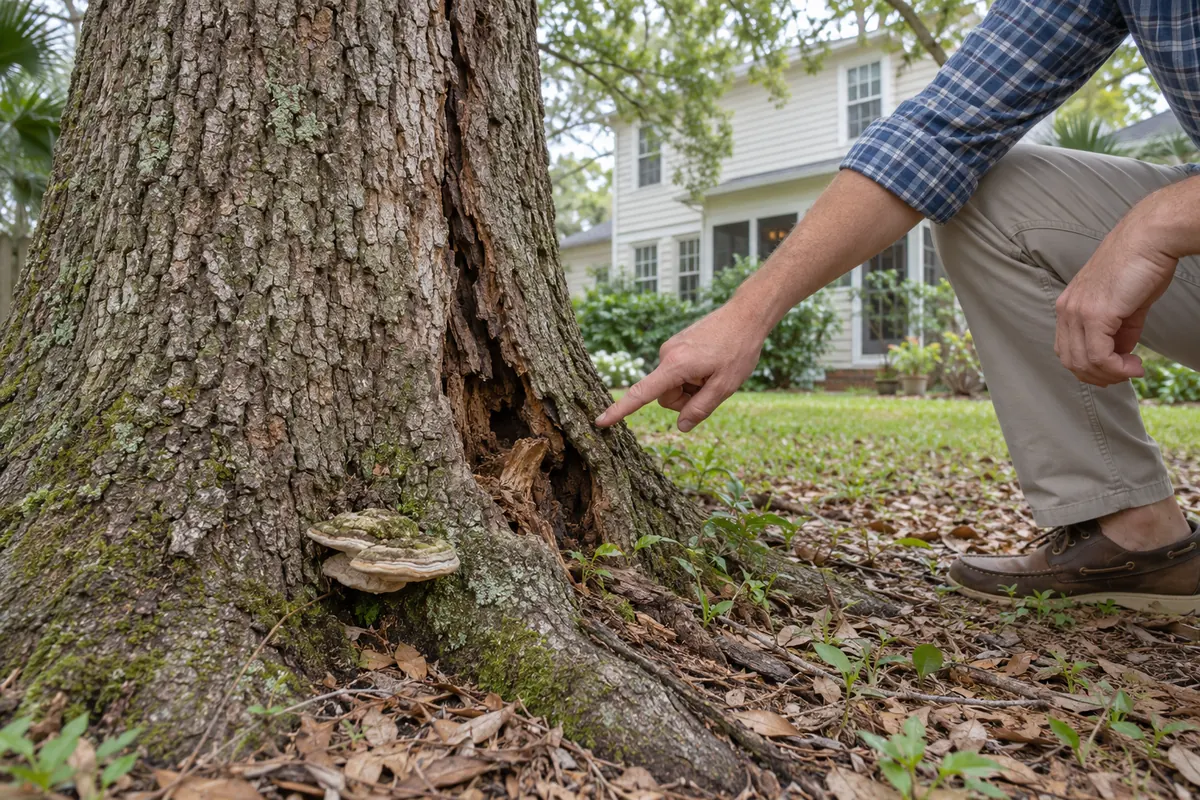
Clemson’s hurricane fact sheet lists these signs of decline or structural trouble:
- Cavities in the main trunk or large branches.
- Cracks or splits in the bark, or bark peeling away.
- Insect activity, such as bore holes.
- Old pruning wounds that look rotten instead of healed.
- Two trunks joined in a tight V with bark pinched between them.
Internal decay is not always visible, Clemson adds, until a trunk splits in a storm. If a tree within striking distance of your house shows any of these signs, have it looked at by a qualified professional, such as an ISA Certified Arborist, before the season.
Should you trim trees before a hurricane?
Yes, if it is the right kind of pruning and it happens early. Clemson says properly pruned trees survive hurricanes better than unpruned or badly pruned ones, and that structural pruning builds a limb framework with the strongest possible wind resistance. It also warns that topping, or “hat-racking,” makes trees more likely to fail in the wind (Clemson News).
- Good pre-storm pruning: removing dead, broken and weakly attached limbs, and correcting weak structure on younger trees.
- Bad pre-storm pruning: topping, cutting big limbs back to stubs, or stripping most of the leaves from the crown.
Heavy pruning can count as removal, and need a permit, in some towns. The permit guide has the rules by town. For costs and timing, see tree trimming; to decide between trimming and removal, see our trimming vs. removal guide.
Should you cut back palmetto fronds before a storm?
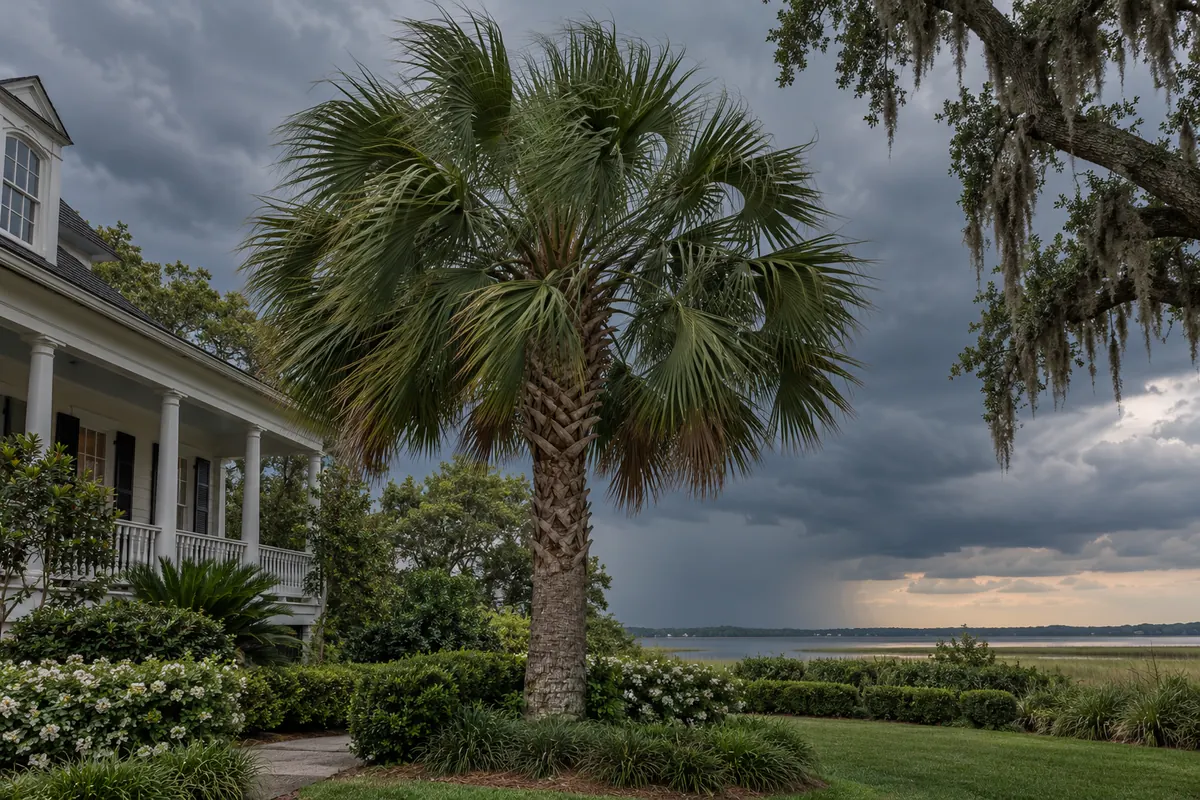
No. Leave the green fronds on. University of Florida Extension reports that observations of palms after the 2004 and 2005 hurricane seasons showed that “hurricane-cut” palms, with most of their leaves removed, were more likely to have their crowns snapped off than palms with fuller crowns (UF/IFAS, Pruning Palms). The same publication says completely dead leaves can always come off, and that fronds with tips above horizontal (the 9 o’clock to 3 o’clock line) should not be removed.
Clemson already rates the sabal palmetto as highly wind resistant and highly salt-tolerant (Clemson HGIC). Removing dead fronds and old flower and fruit stalks is enough. More on palmettos and live oaks is in our Charleston tree care guide.
What about trees near power lines?
Leave them to the utility and to trained crews. Santee Cooper says: “Never try to trim around a power line yourself even if it is on your property.” For a branch on the service line to your house, Santee Cooper customers can call 800-804-7424 at least a day ahead to have the line disconnected while a crew trims, at no charge. If your power comes from Dominion Energy or Berkeley Electric Cooperative, call them instead.
More on power lines, SC811 and checking a crew’s insurance is in the permit guide. To vet a crew step by step, use our checklist for hiring a tree service.
What to do with fallen trees and debris after the storm
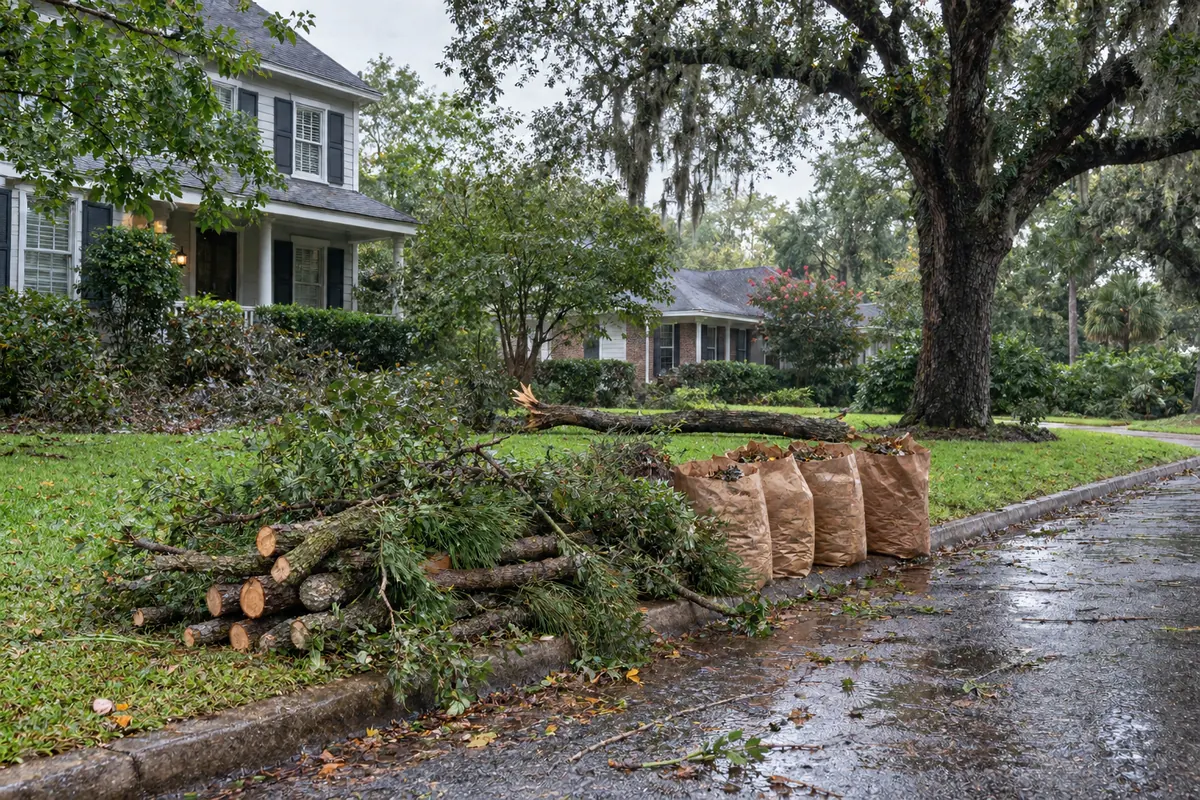
Cleanup on your own lot is your job, not the government’s. FEMA says debris removal from private property is the property owner’s responsibility. Photograph first, call your insurer, keep the receipts.
- City of Charleston curbside rules: tree limbs and stumps cut to 4-foot lengths and 4 inches in diameter, stacked at the curb clear of obstructions; leaves and twigs in brown paper bags; no household garbage mixed in (City FAQ). After a major storm the City may announce different pickup rules, so check its notices.
- If a tree service does the work: the same City FAQ says debris a contractor creates inside the City must be removed by the contractor. Make sure the written quote includes haul-away.
- Other towns: Mount Pleasant, North Charleston, Summerville and the County set their own pickup rules. Check your town’s website.
Insurance. The Insurance Information Institute says homeowners policies generally cover a tree that falls on your house, and the cost of removing it, generally up to about $500 to $1,000. If the tree hits no insured structure, there is generally no coverage for removing it, and damage from poor maintenance is not covered. Your own policy decides, so check its declarations page.
Do you need a permit to remove a storm-damaged tree?
Often yes, but the process is usually simpler for a dead or dangerous tree. Most Charleston-area ordinances approve removal of a hazardous or storm-damaged tree with documentation, and several have emergency rules after a declared storm. The details change by town, so read the dead, dying or dangerous trees section of our permit guide before anyone cuts.
In Mount Pleasant, for example, removal requests for a declining or damaged tree are filed online with a $50 non-refundable fee (Town tree page, read October 15, 2026).
If a tree is already on your house or blocking your driveway, see emergency tree removal. For what removal usually costs in each town, see our tree removal cost guide. We connect you with independent, insured local pros (how it works); the quote is free and there is no obligation.
Sources
Every fact above comes from one of these pages, read October 15, 2026. We do not add our own estimates. This site is a referral service, not a weather service, an arborist or a government office: follow official evacuation and safety orders, and have a qualified professional (such as an ISA Certified Arborist) assess any specific tree. Local pickup and permit rules change, so confirm with your town.
- Clemson HGIC: Managing Trees for a Hurricane-Resistant Landscape (Janet W. Steele, March 13, 2026)
- Clemson News: Now is time to prepare landscapes and gardens for hurricane season (May 30, 2019)
- National Hurricane Center: Tropical cyclone climatology
- UF/IFAS: Pruning Palms (EP443)
- Santee Cooper: Residential tree trimming
- FEMA: Debris removal from private property (April 11, 2024)
- Insurance Information Institute: If a tree falls on your house, are you covered?
- City of Charleston: Garbage and yard waste FAQ
- SC Emergency Management Division: 2026 South Carolina Hurricane Guide
Frequently asked questions
How do you protect trees from hurricane wind damage?
Check the trees that could reach your house before the season, have dead and weak limbs pruned out properly (never topped), remove trees with serious defects, and plant wind-resistant species such as live oak and sabal palmetto at least 1 to 1.5 times their mature height from the house, as Clemson Extension recommends.
Should I trim my trees before a hurricane?
Yes, early in the season and done properly. Clemson says properly pruned trees survive hurricanes better, while topping makes trees more likely to fail. Avoid heavy last-minute cutting when a storm is already forecast.
Can I trim a tree that is touching a power line?
No. Santee Cooper says never to trim around a power line yourself, even on your own property. Call your utility; for a service line to your house, Santee Cooper can disconnect it at no charge while a crew trims.
Should I cut my palmetto fronds before a hurricane?
No. UF/IFAS reports that hurricane-cut palms were more likely to lose their crowns in the 2004 and 2005 hurricanes. Remove only completely dead fronds and leave the green ones.
Which trees survive hurricanes best in South Carolina?
Clemson rates live oak, sabal palmetto, southern magnolia, bald cypress, American holly, yaupon holly, eastern redcedar, flowering dogwood and turkey oak high for wind resistance. Water oak, pecan, Bradford pear, maples and pines were commonly damaged in Hurricane Helene.
Who removes fallen trees after a hurricane in Charleston?
FEMA says debris removal from private property is the responsibility of the property owner. In the City of Charleston, limbs cut to 4 feet long and 4 inches across can go to the curb; debris from a tree service must be hauled away by the contractor. Homeowners insurance generally pays to remove a tree only if it hit an insured structure.